Get Full Government Meeting Transcripts, Videos, & Alerts Forever!
Get email alerts on the Infrastructure Federal Funding topic
No spam. Unsubscribe anytime.
Alaska Municipal League reports $1.3 billion in federal awards but warns of risk from federal policy shifts
Summary
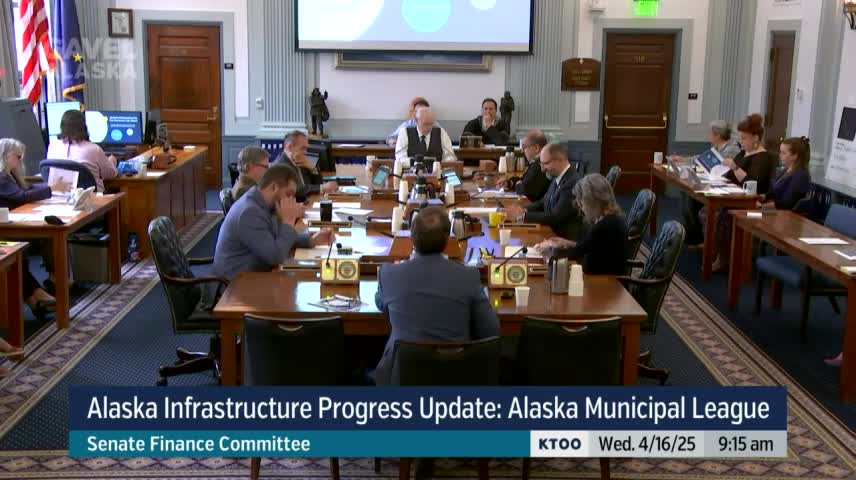
The Alaska Municipal League (AML) told the Alaska Senate Finance Committee on April 16 that it and its partners have helped bring roughly $1,300,000,000 in federal infrastructure award dollars to Alaska but cautioned that recent federal policy changes and agency staffing reductions threaten some projects.
The Alaska Municipal League (AML) told the Alaska Senate Finance Committee on April 16 that it and its partners have helped bring roughly $1,300,000,000 in federal infrastructure award dollars to Alaska but cautioned that recent federal policy changes and agency staffing reductions threaten some projects.
“The last few years have been an infrastructure decade,” AML Executive Director Nils Andresen said, adding that AML and partners focused on maximizing the state’s share of funds created by the Infrastructure Investment and Jobs Act (IJA) and, later, the Inflation Reduction Act (IRA). He said AML-led grant-writing and technical-assistance efforts produced 214 applications, 70 successful awards and about $1.3 billion in grant dollars to Alaska for FY2023–FY2025 work.
The update matters because AML said the awards fund water and wastewater, energy and grid resilience, broadband, ports and ferry service, and other projects in rural and tribal communities. Andresen told the committee those funding streams have allowed Alaska to meet an earlier internal goal of roughly $3 billion a year in federal infrastructure investment, but he warned that some program funds remain unobligated and that a change in federal priorities could reduce or cancel awards.
AML outlined three principal barriers that remain: local matching funds, limited capacity at eligible local entities to prepare and manage projects, and certain federal procurement rules (described by AML as “Build America by America”) that raised project costs for Alaska communities. Andresen said matching funds remain “one of the biggest barriers” and credited recent state appropriations to the Denali Commission for helping communities meet match requirements.
AML provided program-level details: according to the presentation, some federal transportation and infrastructure programs are only partially obligated or distributed (speaker cited roughly 68% obligated overall for a set of programs and about 35% distributed to grantees in one dataset), and several grant lines had low obligation rates (examples cited: airport-related funds ~25% obligated, Port Infrastructure Development Program ~12.9% obligated, Safe Streets for All ~12%, culvert removal ~3.9%). Andresen also listed recent large awardees including Alaska Energy Authority, ANTHC and University of Alaska Fairbanks and highlighted programs such as the federal “Solar for All” and other IRA-funded energy grants.
AML described tools and services it has built or launched to help communities compete for and implement awards: a public web portal (akfederalfunding.org), an Alaska Transportation Hub and an Alaska Energy Hub to collect and evaluate project proposals, in-house grant-writing services offered at low cost, cohorts for shared learning, an Alaska Infrastructure Development Symposium, and shared-service offerings for planning, reporting and asset management. Andresen said AML has grown from about three staff when he started to 28 staff today and that the organization is expanding planning, reporting/compliance and shared software services (including asset-management and GIS/data platforms) to support small communities.
Committee members asked for staffing and operational detail. Senator Kaufman asked for a thumbnail of AML’s operations; Andresen replied that AML now has about 28 employees and can scale further based on funding and demand.
Andresen warned that changes under the new federal administration—he cited a list of executive orders and a federal “cost efficiency” initiative—have introduced two major risks: (1) agencies are vetting existing awards and could cancel grants at staff, manager or regional director review levels; and (2) federal workforce reductions have removed key local points of contact (he cited the Federal Highway grants division in Alaska as an example where staff accepted early retirement). Those changes, he said, increase uncertainty about whether some awards will be carried through to implementation.
AML urged state-level attention to the shifting federal landscape and described ongoing work to mitigate risk and prepare communities: development of a risk register approach, workforce and housing planning for potential economic development, efforts on procurement and financing (capital stacks, bonds and loan tools), and shared services for reporting and compliance so smaller governments can meet federal grant conditions.
The committee did not take formal action; AML’s presentation was received and committee members asked questions. Andresen closed by thanking the committee and reiterating AML’s intent to continue providing technical assistance and shared services to local and tribal governments.
Less critical details: Andresen noted specific community examples — City of St. Paul, Healy, Fairbanks-area transmission projects, Denali Borough and Skagway — and named partner organizations that AML has worked with, including the Denali Commission, Alaska Department of Transportation, Alaska Energy Authority (AEA), Alaska Native Tribal Health Consortium (ANTHC), Tanana Chiefs Conference (TCC), Golden Valley Electric Association (GVEA), Alaska Housing Finance Corporation (AHFC), the University of Alaska Fairbanks, RuralCap, Alaska Federation of Natives, Foraker Group, EPA, DOE and HUD.
AML said it will continue to host the Alaska Infrastructure Development Symposium and to operate shared services and grant-writing assistance for communities.