Get Full Government Meeting Transcripts, Videos, & Alerts Forever!
Get email alerts on the Organ Donation topic
No spam. Unsubscribe anytime.
Life Center Northwest briefed Alaska lawmakers on organ donation process and gaps for Alaskans waiting for transplants
Summary
Ashley Lind of Life Center Northwest told a legislative lunch-and-learn that 154 Alaskans are waiting for transplants, that Alaska has no in‑state transplant center, and described how organ allocation, family consent and transport logistics shape whether donated organs reach recipients.
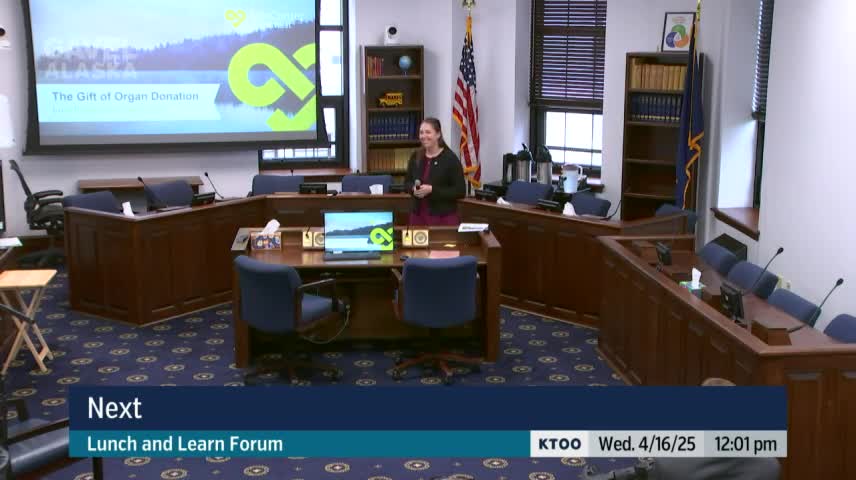
Ashley Lind, manager of the aftercare team at Life Center Northwest, told a lunch‑and‑learn hosted by Representative Prox on the role her organization plays in organ and tissue donation and the obstacles facing Alaskans who need transplants.
"It's truly been a privilege of mine," Lind said, describing the families she has supported in nearly 10 years with the nonprofit. She gave several statistics about need and process: more than 100,000 people in the U.S. are waiting for transplants; about 2,000 of those live in Life Center Northwest's service region; and 154 Alaskans were on the transplant waiting list at the time of her remarks, 137 of whom need kidneys.
Lind said Life Center Northwest is a federally designated organ procurement organization (OPO) serving Alaska, Montana, North Idaho and Washington, and that the nonprofit covers the largest geographic OPO territory in the country. She described how hospitals determine medical eligibility, how the United Network for Organ Sharing (UNOS) manages the national waiting list and allocation, and how the organization supports donor families from the hospital through grief services.
Lind explained the clinical threshold for deceased organ donation: an individual generally becomes a potential deceased donor only after a physician has declared that further life‑saving efforts are not possible and, in some cases, after brain‑death testing or determination of circulatory death. She noted that "less than 1 percent of people who die are able to be organ donors," because donors typically must be in a hospital on ventilated life support for organs to remain viable for transplant.
She described the logistics of allocation and transport: about half of organs recovered by Life Center Northwest remain in the Pacific Northwest, and the remainder travel across the country when the best match is found elsewhere. Lind cited the example of a donor, Mark Cook Jr., whose heart was flown from Juneau to Boston. She also described the recipient Patrick Holland, a Fairbanks resident who received a heart in March 2023 after a prolonged wait, and who now volunteers in his community.
Lind outlined family‑support and cultural practices the OPO provides, including hospital "honor walks," flag raisings and memory‑making activities; she said those supports are available to every donor family for as long as they want them. She also described how Life Center Northwest works with hospitals to accommodate cultural and religious burial practices and same‑day funerals when possible.
On allocation and fairness, Lind said the OPO does not control the transplant waiting list and that UNOS administers allocation. She acknowledged public concerns about "out‑of‑sequence allocation," explaining that organs may be moved outside a regional sequence only after local matches are exhausted, and that OPOs coordinate with other agencies rather than making unilateral decisions.
Audience members asked several technical and practical questions during the presentation and Q&A: who determines clinical eligibility (hospital physicians do, and the OPO performs medical assessments); whether motorcycle‑accident victims can be donors (tissue and cornea sometimes can be recovered, but organs generally require continued perfusion to remain viable); whether directed donations are possible (yes, but they are rare and must follow ethical and listing rules); and who pays for additional hospital time or transport (the OPO assumes costs tied directly to donation after brain‑death is declared but does not pay for life‑saving care or brain‑death testing; transport and recipient costs are typically handled by the transplanting center, insurers or Medicaid).
Lind encouraged registration and family conversations, noting that people can sign up when applying or renewing a driver's license and online at alaskadonoregistry.org. She flagged April as Donate Life Month and invited legislators to an Anchorage ceremony honoring 2024 organ donors at the Governor's Gift of Life award event in May.
The briefing was discussion‑focused; no legislative actions or votes occurred during the session.
Lind concluded by offering Life Center Northwest as a resource for constituents with questions about donation.