Get Full Government Meeting Transcripts, Videos, & Alerts Forever!
Get email alerts on the School Health Insurance topic
No spam. Unsubscribe anytime.
Senate committee hears SB 5 to let school districts, University of Alaska opt into AlaskaCare
Summary
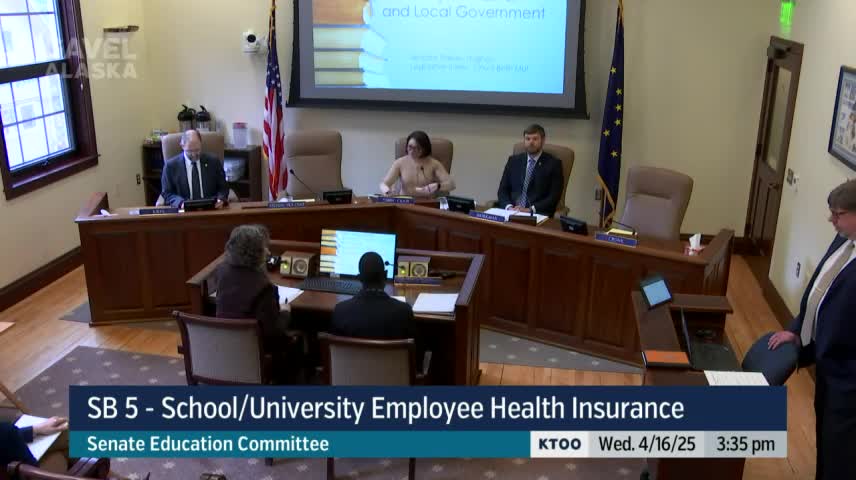
Juneau — The Senate Education Committee on April 16 heard testimony on Senate Bill 5, a measure sponsored by Sen. Shelley Hughes that would allow school districts, the University of Alaska and other local governments to opt into the state employee health insurance pool, commonly called AlaskaCare.
Juneau — The Senate Education Committee on April 16 heard testimony on Senate Bill 5, a measure sponsored by Sen. Shelley Hughes that would allow school districts, the University of Alaska and other local governments to opt into the state employee health insurance pool, commonly called AlaskaCare.
"It would allow school districts, the university, and any local governments that might wish, to opt into the state health insurance pool," Sponsor Senator Shelley Hughes said during the committee hearing, describing the bill as an optional path for entities that conclude joining the state pool would save money.
The bill drew unanimous invited support from district leaders and statewide education organizations, who described rapidly rising health-care costs as a major strain on school budgets. "SB 5 offers a critical option for school districts struggling with the unsustainable and rising health care costs for educators and school staff," Lisa Paradis, executive director of the Alaska Council of School Administrators, told the committee.
Ketchikan witnesses said the costs are acute in some communities. "Our district is currently self insured," Rodney Bridal, identified in testimony as mayor of the Ketchikan Gateway Borough, said. He told the committee his district is budgeting a roughly 10% increase in health-care spending and that per-employee monthly health costs have risen "to over $3,000." Bridal said the district's annual health-care cost is approaching $9,000,000 and that employee salaries and benefits consume a large share of local budgets.
Ketchikan Gateway Borough School District Superintendent Michael Robbins said his district spends "over 20% of our general fund operating budget" on employee health care and that in Ketchikan total compensation costs run higher than national averages. "Nationally, the average district spends approximately 80% of its general fund on salaries and benefits. In Ketchikan, we are at 92%," Robbins said, arguing savings on health care could be reinvested in student services and staffing.
Smaller and rural districts offered similar testimony. Catherine Gardner, deputy superintendent for the Mat-Su Borough School District, said her district spends "nearly 15% of its total operating budget on health insurance alone" and that Mat-Su premiums rose "by over 40% between 2013 and 2023." Lon Garrison, executive director of the Association of Alaska School Boards, said pooled or member-owned risk arrangements can lower administrative costs and give districts more control over plan design.
University of Alaska benefits staff and the university budget director said the university supports optional participation and has been evaluating partnership possibilities with the Division of Retirement and Benefits. Heather Arana, director of benefits and compensation for the University of Alaska, said the university has "spent the last five years working with the DRB" to assess benefits and welcomed further analysis.
Division of Retirement and Benefits staff told the committee that implementing optional participation would require administrative work and programming. Deputy Director Steve Ramos said the division expects additional eligibility-processing workload and an initial programming price estimate from a subcontractor of about $1,000,000 to create the interfaces and eligibility files to serve multiple new groups. Ramos said the division expects to add several full-time positions to handle eligibility processing as membership grows.
Committee members raised recurring concerns about the bill's mechanics and potential effects on the existing AlaskaCare risk pool. Senators asked whether the bill gives the commissioner of the Department of Administration discretion to accept or deny applicants, how separate or commingled the new participants would be within AlaskaCare, and how the bill would apportion excess-loss (stop-loss) insurance. Senator Bjorkman warned optional entry could create adverse selection, with high-cost groups entering the state pool and lower-cost groups remaining separate, raising costs for AlaskaCare members.
Sponsor Hughes and staff acknowledged some details are unresolved and said they will work with the Department of Administration and legal counsel on clarifying language. The sponsor also noted the bill includes a provision to allow districts to amortize transition costs over 10 years; multiple testifiers described a 10-year transition or reimbursement schedule as part of the proposal.
No formal committee action was taken. Chair Senator L. Tobin closed public testimony and announced the committee will hold SB 5 until a future meeting and work with the bill sponsor on possible amendments. "Please work with the bill sponsor in my office on any amendments that you would like to consider or offer," Tobin said before adjourning.
Why it matters: Testimony at the hearing framed SB 5 as a budget tool for districts facing double-digit health-care cost increases that consume growing shares of education funding. Supporters argued voluntary access to a larger risk pool could lower premiums and administrative burdens and free money for classroom programs and staff. Opponents and cautious members urged designers to address adverse selection, commissioner approval standards, fund mechanics for start-up costs and how excess-loss insurance would be apportioned.
Next steps: Committee members asked for additional information from the Division of Retirement and Benefits and the Department of Administration on enrollment mechanics, claims pooling, and the fiscal impact of programming and staffing. The committee held the measure for a future meeting and requested the sponsor and state staff collaborate on clarifying amendments.