Get Full Government Meeting Transcripts, Videos, & Alerts Forever!
Get email alerts on the Stormwater Comprehensive Plan topic
No spam. Unsubscribe anytime.
Puyallup studies stormwater comprehensive plan update; council hears about new permit rules, projects and $1.1B funding gap
Summary
City staff and consultants briefed the City Council on a 20-year stormwater comprehensive plan update, new state permit requirements, near-term capital priorities including Fourth Street downtown upgrades, and staffing and funding needs; councilmembers asked about pond reuse, culverts and beaver management.
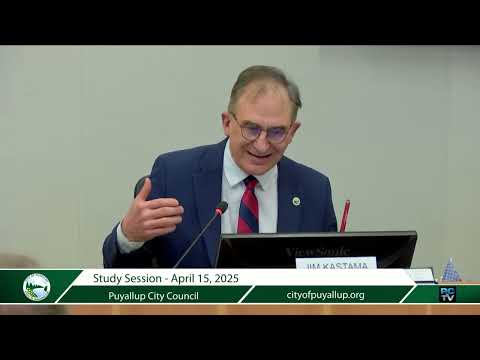
Puyallup City officials presented a draft update to the city’s stormwater comprehensive plan at a council study session on April 15, 2025, laying out new regulatory requirements, a six‑year implementation program and a prioritized capital list that city staff say will require more staffing and grant funding to implement.
The plan, introduced by Kelton Parker, stormwater engineer for the City of Puyallup, and presented with consultant Margaret Hales of Brown & Caldwell and City Engineer Hans Hunger, describes the municipal system — “stormwater is rainwater and runoff that is collected through our drainage system,” Parker said — and the work needed to meet an updated municipal stormwater permit (Phase 2) and the Clean Water Act obligations the permit implements.
City staff said the plan’s near‑term goals are to prioritize capital projects for the next six years, map stormwater‑beneficial tree canopy, improve asset management and create a new program to address stormwater at existing developed sites (SMED). Parker said SMED’s target is to fund or implement treatment that serves 6.9 acres of drainage area, a number derived from the state permit’s formula for the city’s population. The plan also calls for mapping treated and untreated drainage areas and adding code language to address illicit discharges, including PFAS and PCBs.
Staff described the system inventory in the plan and the scale of assets to manage: eight drainage basins, eight stormwater pump stations, 96 outfalls and about 459 stormwater facilities. The presentation lists more than a hundred identified stormwater projects; staff highlighted nine priority capital projects and 37 second‑tier projects. One priority project is the multi‑phase Fourth Street stormwater upgrade to reroute downtown flows to the Puyallup River; staff estimated the total cost for all phases at about $25 million.
The six‑year implementation table (2025–2030) as presented includes three ongoing projects, six priority capital projects, six modeling studies, four new programs, a number of program expansions to accommodate growth and roughly six new recommended full‑time positions to run expanded inspection and repair‑and‑replacement programs. Parker noted some programs already exist and many will be expanded; he said the city’s existing street‑sweeping program meets much of the new permit requirement but will need more documentation for annual reporting.
On funding, Parker showed a large gap between available budget and the plan’s recommendation; the slide cited a roughly $1,111,000,000 shortfall across the plan horizon. He added the city has averaged about $3 million per year in stormwater grants since 2017 and has been successful securing state grants, but that grant income fluctuates with project readiness and competitiveness.
Council members pressed staff on details. Council member Whiting asked what “6.9 acres” refers to; Parker replied it is “6.9 acres of drainage area that we have to” treat under the SMED requirement. Council member Johnson asked whether the city reassesses older retention ponds that appear underutilized; Parker said designs and soils vary and some ponds may appear dry except during large storms, but that the rehabilitation program has in some cases relieved downstream flooding. Council member Johnson asked staff to explore a process for property owners or applicants to request repurposing underused stormwater facilities; staff said redevelopment occasionally replaces ponds with vaults or other solutions but that a formal reassessment process was not in the plan and could be pursued.
Council members also asked about culverts and an emergency repair on Deer Creek. Hans Hunger said the city had applied for and was working to secure a state grant of about $8.3 million to replace four culverts that had failed and washed out a road, cutting off several properties. Parker said the city has roughly 100 culverts identified in an R&R program for condition assessment and prioritization.
Other items emphasized in the briefing: a new mapping requirement for stormwater‑beneficial tree canopy, development of the SMED retrofit program to treat defined acres of existing development, three new repair‑and‑replacement programs (infrastructure, pump stations and culverts), and a small beaver‑management item to address beaver dams that cause localized flooding; Parker gave an example of a case on Deer Creek that required a permitting “notch” to relieve backwater.
Parker said the final draft was completed in November 2024 and that staff had scheduled a public hearing and first reading for April 29, 2025, as the next steps toward formal adoption.
The council and staff agreed to follow up on specific requests, including more detail on grant source splits and a potential process to assess and, where appropriate, repurpose underutilized stormwater ponds.
Ending: The presentation will return for public hearing and ordinance consideration; staff requested council direction on next steps and additional detail to support budgeting and grant applications.