Get Full Government Meeting Transcripts, Videos, & Alerts Forever!
Get email alerts on the Historical Society topic
No spam. Unsubscribe anytime.
St. Louis County Historical Society introduces new executive director, outlines map-report steps
Summary
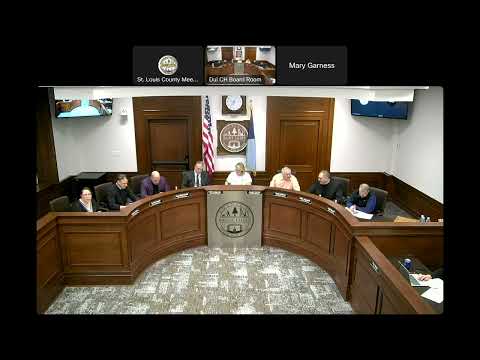
Jeff Wenzel, president of the Board of Governors for the St. Louis County Historical Society, told the St. Louis County Board of Commissioners during a public-comment session that the society has hired Wayne Ganaway as its new executive director and is beginning to implement recommendations from a recent map report.
Jeff Wenzel, president of the Board of Governors for the St. Louis County Historical Society, told the St. Louis County Board of Commissioners during a public-comment session that the society has hired Wayne Ganaway as its new executive director and is beginning to implement recommendations from a recent map report.
The update matters because the society houses county historical records and programming while also receiving county support, and commissioners used the public-comment time to press the society on finances, governance and the pace of organizational change.
Wenzel introduced Ganaway and summarized the society’s approach to a 32-item map report, saying the recommendations are being treated “as a checklist of things that we need to be doing.” Wenzel added that the society has already completed at least one item: “item number 7 is to turn over our 2 d archives to UMD. UMD already has been housing them for a long time. It made sense to do that, and we’ve already done that.”
Wayne Ganaway, identified by Wenzel as the society’s new executive director, said he was returning to the county after earlier work in the region. “I’m really thrilled to be back in St. Louis County. I was here from 02/2009 to about 02/2012 with the National Scenic Byway Program,” Ganaway said. He described the job as a “refreshing connection” and said he intends to “take on those challenges, directly, transparently, and really, look to write a new chapter” for the organization.
Commissioners used the public-comment period to press for more financial and governance details. Commissioner Boyle praised the map report and requested follow-up conversations: “I just wanted to say, thank you for that map, of where you're heading for the next few months,” Boyle said, and asked for additional discussions about ongoing organizational fundraising and the county’s share of support.
Commissioner Grimm raised governance concerns that some in the county have flagged for several years, including whether a former board chair continues to play an outsized supervisory role. Grimm said there had been “a lot of kind of missed opportunity for engagement with the county about what the specific relationship is with the county, what funding has been,” and asked whether a “former board chair is still there 40 hours a week directly supervising the executive director,” a practice Grimm linked to staff burnout and politicization of the society’s operations.
Wenzel and Ganaway both acknowledged past turnover and relationship strains and said they are seeking to move forward. Ganaway said he had delayed wide circulation of the map report until the society could bring answers to the commissioners and described his management approach: “I’m a career military officer. So you come to the boss with problems and then the solutions.” He told commissioners he intends to address concerns after the society’s annual meeting.
The society’s annual meeting is scheduled about two weeks after the public-comment session, according to Ganaway: “We also have our annual meeting in 2 weeks from tonight.” Ganaway said he is prioritizing that meeting as a moment for a “fresh start” while promising follow-up with county officials on the outstanding questions.
No formal motions or votes were taken during the public-comment session. Commissioners and society representatives agreed to continue conversations about fundraising, the society’s relationship with the county and internal governance arrangements.
Details from the transcript
• Transfer of 2D archives to UMD: described by Jeff Wenzel as completed and linked to item 7 of the map report.
• Map report: referred to as a multi-step process (Wenzel said it is “step 4 in a 6 step process”) and as containing about 32 recommended items the society plans to use as a checklist.
• Governance concerns: Commissioner Grimm asked whether a former board chair still supervises the executive director and whether job applications are routed to that person; the transcript records questions and requests for follow-up rather than formal findings or actions.
• Annual meeting: Ganaway said the society’s annual meeting is two weeks away and that some governance and operational concerns will be addressed after that meeting.
Ending
Speakers said they will continue follow-up discussions with county staff and commissioners about fundraising, the society’s county relationship and governance arrangements. The public-comment period ended with the board noting the start of the official meeting at 10:00 a.m.