Get Full Government Meeting Transcripts, Videos, & Alerts Forever!
Get email alerts on the County Finance topic
No spam. Unsubscribe anytime.
Harris County CFO reports stronger‑than‑expected revenues; commissioners weigh replacing payroll software with ADP
Summary
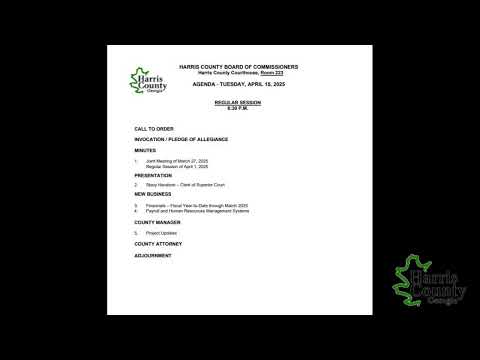
Harris County commissioners heard a fiscal update and a proposal to replace the county’s payroll system at their April 15 regular meeting.
Harris County commissioners heard a fiscal update and a proposal to replace the county’s payroll system at their April 15 regular meeting.
CFO Elizabeth Barfield told the board the county’s year‑to‑date financial report through March 2025 shows higher than budgeted grant receipts and several large capital outlays. “It’s different than anything you’ve seen,” Barfield said of the new report format designed to show four years of year‑to‑date figures, budget comparisons and variances.
Barfield said the county received about $914,000 in LMIG receipts this fiscal year (budgeted at $930,000) and that some funds categorized as LRA were not budgeted, which explains variances in the general fund revenue column. On the expense side she said the sheriff’s department is over budget because some items were purchased against SPLOST 2025 before the SPLOST receipts were collected; the general fund will be reimbursed when those SPLOST proceeds arrive.
Barfield detailed other capital and grant activity: ARP (American Rescue Plan) reserves are being used for payments on an elevated water tank (three payments made so far, with two additional payments of about $800,000 anticipated); the Public Improvements Authority (PIA) has paid roughly $3.5 million toward the county’s E‑911/public safety system (a roughly $1.2 million down payment and a $2.3 million construction payment), and 2019 SPLOST expenses included about $1.4 million for courthouse renovations and $1.6 million for a Public Works building. Barfield reminded the board those PIA/E‑911 payments came from bond proceeds, not the general fund.
The financial presentation moved into a separate but related discussion about enterprise software. Barfield and staff summarized recurring problems with the county’s current Cassell system: slow connectivity (the vendor’s servers are in a different time zone), an accounts‑payable module that has complicated the fiscal 2024 audit, lack of attachment functionality in the budgeting module, and manual payroll workarounds that require extra journal entries and administrative steps.
Barfield said payroll processing relies on one person, identified in the meeting as Chris, which creates a single‑point‑of‑failure for an essential function. She described an instance when Chris processed payroll from home while arranging funeral services after her father died. Commissioners used that example to emphasize operational risk and the burden of manual processes.
ADP representative Lisonbee Green presented ADP’s cloud‑based payroll, time & attendance and HR modules and described ADP as “one system of record.” Green said ADP processes “one in five” paychecks globally and offers a mobile employee portal for pay stubs, W‑2s and time records. Commissioners and staff asked whether ADP would interoperate with Cassell; Green and staff said ADP would export payroll results and a sample chart of accounts/journal entries that can be mapped to a CSV import for Cassell.
Cost and timing were discussed but no contract was approved at the meeting. Commissioners asked about current payroll costs and implementation time. Staff said Cassell’s payroll service costs about $3,500 per month (roughly $42,000 per year). ADP’s presenter estimated an implementation timeline of about 12 days (including training) once the county signaled readiness; she said the vendor’s regional service center for the area is in Augusta and that ADP can provide county references.
Barfield told commissioners she would “pave the way to include [ADP] in the audit and in the budget,” indicating a directive to staff to budget for and further evaluate ADP but no formal procurement decision was taken at the meeting. Commissioners praised the new financial report format and asked staff to continue work on audit readiness and resolving Cassell‑related issues.
Votes at a glance - Approval of minutes (joint meeting of 03/27/2025 and regular session 04/01/2025): motion carried; mover/second not specified in the record. - Motion to enter executive (closed) session for litigation and personnel: motion carried; mover/second not specified in the record. - Motion to adjourn: motion carried; mover/second not specified in the record.
Next steps noted at the meeting: finance staff will include ADP costs and implementation planning in the upcoming audit and the FY‑26 budget process; no procurement or purchase order was approved at this session.