
National Grid outlines smart-meter rollout for Nantucket, answers questions on safety and data
Get AI-powered insights, summaries, and transcripts
Subscribe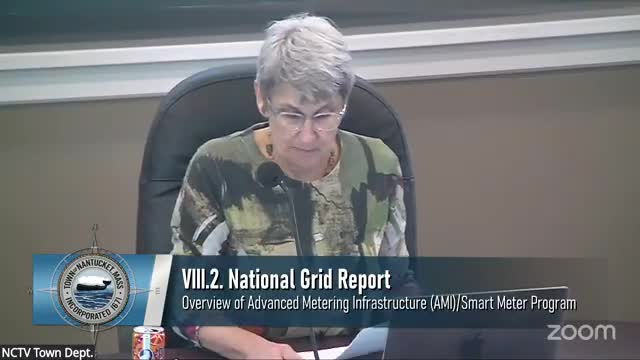
Summary
National Grid presented its Advanced Metering Infrastructure (AMI) plan for Nantucket on April 16, describing timeline, technical details and customer outreach; company and residents discussed radiofrequency exposure, data access and opt-out options.
National Grid officials told the Town of Nantucket Select Board on April 16 that the utility plans to install advanced “smart” meters and supporting communications devices on the island, and described customer benefits, installation steps and public outreach.
At a presentation in the board meeting, Lisa Morguera, National Grid’s lead for community engagement in Massachusetts, said the project—officially called Advanced Metering Infrastructure or AMI—includes smart meters, a communications network and back-end systems that enable two-way data flows. “This is commonly referred to as our smart meter program,” Morguera said.
Why it matters: National Grid said the upgraded meters will provide near-real-time, 15‑minute interval usage data, remote connect/disconnect capability and more detailed outage detection. Officials said the program supports future clean‑energy policies and enables more sophisticated time-of-use pricing and grid-management tools.
National Grid projected network build-out on Nantucket this spring and summer and a tentative start for meter installation in October 2025, with a roughly six‑month installation window aimed to finish before the island’s busy season. Jesse Harvey, who leads AMI deployment for Massachusetts, said the company has completed about 24,000 meter upgrades elsewhere in the state and expects to “touch somewhere between 1.4 and 1.5” million meters statewide by the end of 2027.
Technical details and installation: Diana Rivera, National Grid’s field area network manager, described three pole‑mounted device types that form the island communications network; after a redesign the company reduced planned devices from 39 to 35. Rivera said eight devices are already installed and communicating; others are in survey, permitting, design or ready-to-install stages. Mark Correa, National Grid manager of special operations, said a network must be in place and stable before meters are installed.
Customer experience and outreach: National Grid described a phased outreach plan: a 90‑day community awareness campaign, followed by 60/30/10‑day direct notices to customers before each installation, a door hangar at the time of work and a post‑installation letter with links to online resources. Technicians will knock before a meter swap; customers need not be home for the roughly two‑to‑five minute power interruption.
Questions from residents focused on health, privacy and practical effects. Amy Eldridge, a resident who has followed smart‑meter discussions, asked whether new meters are “chronically running” and compared RF exposure with existing household devices. Jesse Harvey and Mark Correa said the replacement meters report far more frequently than older drive‑by meters (reporting intervals in 15‑minute blocks rather than once a month) but that radiofrequency (RF) emissions are low and comparable to many household devices. Morguera noted an opt‑out option exists but that it carries incremental fees; opt‑outs would receive a non‑communicating meter and manual reads. National Grid also said the company will not have access to appliance‑level disaggregation in customer-facing apps; that functionality is provided by a third‑party app (SENSE) that customers may use at no cost, and appliance‑level detail is accessible to customers through that app rather than to customer service agents.
On safety and grid benefits: Officials said meters will provide alerts for outages and voltage irregularities, reduce truck rolls for routine reads and enable faster outage response. National Grid emphasized the meters do not use a customer’s home Wi‑Fi; the network runs on the company’s field area network.
Next steps and timeline: Representatives told the board the island network must be completed and stable before meter swaps begin; National Grid said Nantucket’s meter installs are forecast to begin in October 2025 and be completed in about six months, subject to change. Officials encouraged residents to review the utility’s smart‑meter materials and asked the town to help share outreach information.
Residents who raised health or privacy concerns were told how to request opt‑out and where to find technical material; National Grid said it will continue public engagement as build-out proceeds.