Get Full Government Meeting Transcripts, Videos, & Alerts Forever!
Get email alerts on the Camping Ordinance topic
No spam. Unsubscribe anytime.
Committee advances revisions to Salem camping ordinance after police presentation and public testimony
Summary
The Salem City Council committee advanced proposed edits to Ordinance 24-31 on camping after police described health and safety hazards at encampments and residents and service providers debated storage, notice periods and shelter availability. The committee voted 4–1 to refer the revisions to the full council with a positive recommendation.
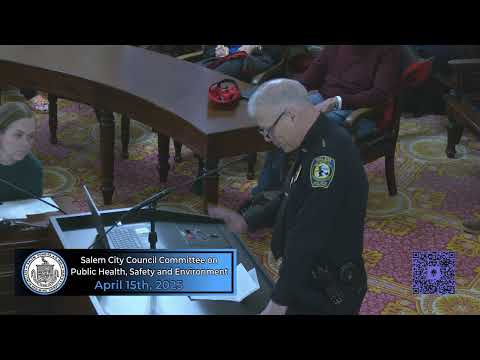
Salem — The Salem City Council Committee on Public Health, Safety, and Environment met April 15 and voted to send proposed revisions to Salem City Ordinance 24-31, the city—camping ordinance, to the full council with a positive recommendation. Councilor Stott moved the referral and Councilor Harvey seconded; the committee recorded a 4—to—1 vote in favor and one no vote.
The changes under consideration were presented by Police Chief Lucas Miller and members of the Salem Police Department—Community Impact Unit. Chief Miller said the ordinance passed last year to address tent encampments near the South River and other public spaces and that enforcement showed hazardous conditions at some sites. "The changes are intended to address the very real danger of people camping in the woods," Miller said, adding the revisions are meant to balance public-safety and shelter goals.
The committee and staff outlined several concrete edits. Key proposals include narrowing what property the police will store (limiting storage to identification documents and valuables pending an internal city storage policy), clarifying that a person's behavior that prevents admission to an otherwise available shelter does not make shelter "unavailable," adding a provision tied to "red-flag" dry-fire warnings to allow faster removal in high-fire-risk periods, and adjusting notice and removal timelines for camps the city deems an immediate public-health or safety hazard. The draft also changes language referencing the health agent to the health department and adds a sentence saying departments will work on implementing regulations tied to the ordinance.
City Solicitor Beth Renard told the committee the police had not needed large-scale storage after the initial ordinance and recommended the police keep only identification documents and valuables in the department—storage program pending a separate city storage policy to further define eligible items. Several councilors pressed for a clearer definition of "valuables," noting the difference between monetary property and personal or sentimental items. Chief Miller said the department applies a reasonableness standard and that historically the department has retained property when people were incapacitated or taken into custody.
Capt. John Burke and Sgt. Sean Andrus of the Community Impact Unit described conditions observed at encampments. Andrus provided departmental statistics for 2024: "In 02/2024, we had 2,997 calls involving unhoused individuals in the city of Salem. That is 7.33% of all calls for the Salem Police Department that year," he said, and reported 259 arrests or summonses and 97 unhoused people victimized by crime. Burke and other officers described large volumes of refuse, hypodermic needles and open flames at some sites; Burke said public works crews found "upwards of a thousand hypodermic needles" during a removal and described torn tents and fire damage.
The public-comment period drew a mix of positions. Several residents supported the revisions as a public-safety measure. Tony Duffy, a Salem resident, called the pictured conditions "absolutely unacceptable" and urged adoption. Essex County Outreach—staffer Steve Perry said the previous enforcement and outreach had produced housing or treatment for clients, stating, "At least 10 people are in better situations because of the ordinance. We've got them housing, we've got them treatment, and it was a direct result of that sweep." Opponents and service providers argued the ordinance is punitive without a citywide plan for housing and services. Skyler Clark, who testified against the changes, asked the council to publish the related policies (the city storage policy and a shelter-availability list cited by staff) before changes are approved and warned that shortening notice periods would harm people living outdoors.
Council debate focused on implementation details. Multiple councilors asked that the city storage program policy be completed and published before narrowing the ordinance—language on stored property; Councilor Davis and others said a change from a 72-hour removal window to a proposed 12-hour requirement for individuals after shelter becomes available could be too short for people to move and retrieve belongings. Staff said the 12-hour window in the draft was intended to provide a firmer enforcement option when shelter beds open and that, as a practical matter, enforcement historically involves discretion and outreach.
Action at the meeting: the committee voted to refer the draft revisions, as presented and amended in committee discussion, to the full Salem City Council with a positive recommendation for first passage. The referral passed 4—to—1.
What happens next: the matter will appear at the full council meeting next Thursday for further debate and a formal vote on first passage. The solicitor and police said they are continuing to draft an implementing storage policy and additional regulations to clarify notice areas and other operational details.
Votes at a glance - Motion: Refer the proposed revisions to Ordinance 24-31 to the full council with a positive recommendation for first passage. - Mover: Councilor Stott; second: Councilor Harvey - Committee vote: yes: Councilor Stott, Councilor Jerusalem, Councilor Harvey, Chair Cohen; no: Councilor Davis; tally: 4—yes, 1—no - Outcome: approved (referred to full council)
Ending The committee hearing combined detailed police testimony about health and fire hazards with several hours of public testimony and questions from councilors about definitions, storage logistics and enforcement timelines. Committee members asked staff to finish the city storage policy and the implementation regulations before the full council votes, and the item will return to the council for first passage consideration next week.