Get Full Government Meeting Transcripts, Videos, & Alerts Forever!
Get email alerts on the Procurement Responsible Bidder Ordinance topic
No spam. Unsubscribe anytime.
Evanston committee delays ‘responsible bidder’ ordinance, asks staff to return with narrower local preference and apprenticeship options
Summary
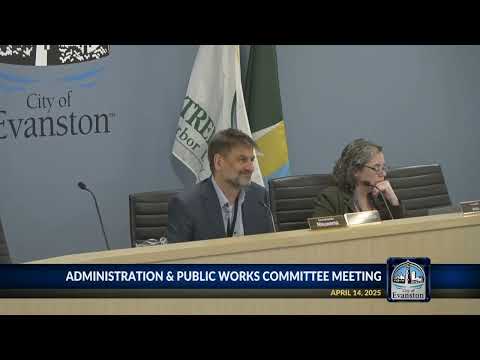
Evanston’s Administration and Public Works Committee on April 14 debated a proposed “responsible bidder ordinance” (Ordinance 23-O-25) and agreed to delay final action while asking staff to craft clearer language on four specified points.
Evanston’s Administration and Public Works Committee on April 14 debated a proposed “responsible bidder ordinance” (Ordinance 23-O-25) and agreed to delay final action while asking staff to craft clearer language on four specified points.
The committee discussed the ordinance, which would add bidder requirements such as a minimum self-performance percentage, apprenticeship participation, a nearby-business preference, and documented experience on similar-size projects. Committee members agreed to send the draft back to staff for refinement and to return the item at the committee’s first meeting in May.
The discussion centered on four staff-identified areas. Chief Legislative Policy Adviser Liza Robertson Young told the committee the draft contains a 25% self-performance requirement (the general contractor must directly perform at least 25% of the services), an apprenticeship requirement tied to Department of Labor–registered programs that have graduated five apprentices per year for the prior five years, a proposed nearby-business preference originally set at 15 miles, and a $25,000 threshold for several RBO provisions.
Committee members expressed divergent concerns. Council Member Harris said the top priority is protecting the ability of small, local Evanston businesses to compete and asked how the ordinance might “box out Evanston businesses.” Several members, including Harris and others, urged caution about imposing requirements that might unintentionally exclude local firms.
Labor representative Jeremy Esparza, business agent for the Laborers Union, spoke in favor of responsible bidder rules and said neighboring municipalities that have adopted similar ordinances “are able to maintain the level of craftsmanship that an apprenticeship standard for a company provides.”
On the four specified areas, committee direction to staff included: - Self-performance: the body asked staff to draft a sliding-scale option based on project size (preferred in committee discussion) while also considering an “added value” alternative; staff was asked to present options in writing so members could compare language. - Apprenticeship requirement: the committee favored adding an experience exemption for employers that hire experienced journeyman-level workers; members also asked staff to draft waiver and threshold alternatives for review. - Nearby-business preference: members rejected the draft 15-mile radius as too broad; the committee asked staff to return with a draft using a 5-mile radius (some members had proposed 3 miles, others preferred no radius, but the working direction was 5 miles for the next draft). The committee also suggested explicitly treating businesses owned by Evanston residents differently (Evanston-resident-owned firms would qualify regardless of business address). - Size-and-scope threshold: members asked staff to compile recent project-value data (2023 and 2024 projects) so the committee can pick an evidence-based dollar threshold rather than an arbitrary number; some members suggested $25,000 is low and requested the data before choosing a final figure.
Members repeatedly said they did not intend to vote on the ordinance that night. Instead, Council Member Reid moved — and Council Member Kelly seconded — a motion to delay the item and bring a revised draft back at the committee’s first May meeting. The motion passed by voice vote.
Staff (Legislative Policy) and representatives from the labor union will prepare revised ordinance text and supporting data for the committee to review at the next meeting. The committee’s discussion emphasized balancing labor and quality standards with preserving opportunities for small Evanston firms and avoiding language that would unintentionally exclude existing contractors.
Looking ahead, the committee asked staff to provide exact draft language for both the sliding-scale and added-value approaches (so members can compare), a proposed experience-exemption or waiver process for apprenticeship requirements, a 5-mile nearby-business preference draft (with an explicit treatment for Evanston-resident owners), and a project-value dataset to guide the size-and-scope threshold decision.