Get Full Government Meeting Transcripts, Videos, & Alerts Forever!
Get email alerts on the Price Fixing Software topic
No spam. Unsubscribe anytime.
Evanston committee opens discussion on banning price‑fixing rental software
Summary
The Housing and Community Development Committee discussed a referral to study and potentially ban software that can coordinate rental prices, directed staff to research local use and legal context and to return with proposed ordinance language after re‑referral from city council.
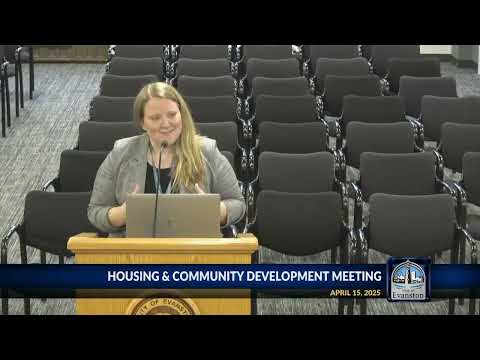
The Housing and Community Development Committee on April 15 discussed a referral to study banning software that can facilitate coordinated rent‑setting among landlords in Evanston.
Liz Williams, planning manager with the City of Evanston, told the committee the referral would focus on technological tools that “help facilitate the manipulation or coordination of rental prices among housing providers, property managers, or real estate firms.” Williams named RealPage and YieldStar as prominent examples cited in national research and noted the U.S. Department of Justice has sued RealPage alleging violations of the Sherman Antitrust Act of 1890.
The referral is for discussion only. Council Member Herrera Karras moved the item for discussion, and Williams asked the committee what additional information staff should gather. Williams said staff’s preliminary local review has found housing providers that use some RealPage products but not the YieldStar pricing component most closely associated with coordinated price recommendations. “We haven’t to date found that any of the housing providers in Evanston are specifically using that component of the software package,” she said.
Committee members asked how enforcement would work and how cross‑jurisdictional pricing decisions might affect Evanston. Commissioner Chloe Thurston asked how to account for providers who operate in larger nearby markets; Williams replied enforcement would likely be complaint‑driven and emphasized staff would need to define precisely what the ordinance would ban and propose an enforcement process and penalty structure.
Commissioner Fran Sweeney and others referenced ongoing litigation and national attention. Williams summarized the legal landscape: the DOJ suit against RealPage remains pending in U.S. District Court for the Middle District of North Carolina and has prompted municipalities such as San Francisco (September 2024) and Philadelphia (late 2024) to adopt prohibitions or related ordinances.
Williams said staff will work to identify which local providers use which software components, consult existing municipal language, and draft proposed ordinance text if the item is re‑referred by city council to the committee. No formal vote or ordinance was adopted; the committee provided direction for staff research and drafting and expects the referral will return to the committee after re‑referral from council.
Williams summarized next steps: gather local usage data, draft ordinance language informed by other cities’ approaches, and propose an enforcement process. The committee did not set a date for return; Williams noted the committee will need a new council referral to bring the item back for formal consideration.
The discussion recorded no formal action beyond the motion to discuss; staff will prepare follow‑up materials for a future meeting following the re‑referral process.