Get Full Government Meeting Transcripts, Videos, & Alerts Forever!
Get email alerts on the Homelessness Camping Ordinance topic
No spam. Unsubscribe anytime.
Salem committee advances revised camping ordinance after police testimony, sends changes to full council
Summary
A Salem City council committee heard police testimony about hazardous encampments, debated proposed edits to the city's camping ordinance (including what property police should store) and voted to keep the original storage language while referring the revised ordinance to the full council with a positive recommendation.
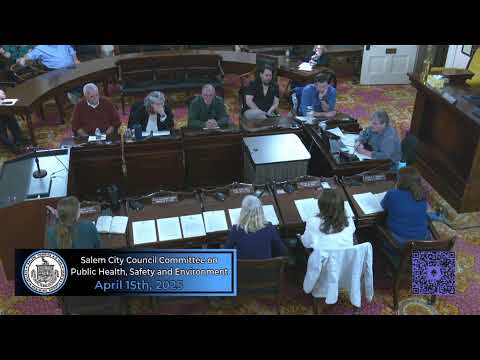
Salem's Public Health, Safety and Environment Committee, meeting jointly with the Committee of the Whole, voted April 15 to refer proposed revisions to the city's camping ordinance to the full City Council after modifying one recommended change and preserving existing language on what property the police will store.
The committee met in the City Council Chamber to consider edits drafted by the city solicitor following a year of enforcing Salem City Ordinance 24-31 ("Camping"). Police officials outlined public-health and safety problems they said arose in multiple encampments and recommended changes intended to improve cleanup authority and allow faster removal when sites become hazardous.
The changes matter, councilors and police said, because recent encampments posed risks to occupants and neighbors. Police Chief Lucas Miller said the city passed the camping ordinance to allow coordinated removals after ensuring shelter space and time for occupants to make arrangements, and that enforcement revealed unexpectedly dangerous conditions: "As city crews worked on the cleanup, it became clear that the conditions in the camp were even more dangerous than what was initially believed, requiring extra care due to the human feces, bloody clothing and used hypodermic needles that were mixed in with other property," he said. Miller told the committee the ordinance worked to remove encampments without arrests but that the proposed edits would let the city address hazards more effectively while "retaining a compassionate view" toward people living outdoors.
Captain John Burke of the Salem Police Department's Community Impact Unit described the Peabody Street encampment and others around the city, showing photographs and incident statistics. Burke said one concentrated site spread across properties and near businesses, with "approximately 10 tents, anywhere from 12 to 18 homeless individuals living there at any given time," and that police logged about 241 calls for service at that location between mid-2023 and 2024. Burke said enforcement crews found sharps and other hazardous waste and "when we closed the Peabody Street encampment, there were upwards of a thousand hypodermic needles found. A thousand." Sergeant Sean Andress described outreach work and said most people reached by outreach accept services: "We take a holistic approach in dealing with individuals as they are. ... Of these parties 62 accepted services, 4 declined," he said.
City Solicitor Beth Renard walked the committee through specific edits, including narrowing what the police would be expected to store. "The first recommendation is to just have the property that's stored by the police department to be those things that are identification, documents, and valuables," Renard told the committee. Councilors questioned how "valuables" would be defined in practice; Renard said an accompanying city storage policy would further define eligibility and that the policy is a work in progress.
Council discussion focused on balancing public-safety risks (fires, sharps, and rodent infestation cited by the police) with protections for people's belongings and the need for shelter. Councilor Davis raised concern about shortening notice periods for removal and the risk of leaving people with little time to relocate. "I just feel so much more comfortable if this was something that was delineated in language between extreme folks that impose extreme risk and those that don't," Davis said.
Public testimony was mixed. Some neighbors and business owners described public-safety problems and urged the council to adopt stronger removal tools. "The city feels different now," said resident Tony Duffy, who urged adoption of the edits. Other speakers, including activists and people working in mutual aid, urged more shelter and services rather than stricter enforcement, questioned the adequacy of the promised storage policy and called 12-hour removal windows too short.
Committee actions
- Motion: "Keep eligible property definition as in the original ordinance" (i.e., do not adopt the proposed change limiting stored property). Mover: Councilor Stott; Second: Councilor Davis. Vote: Stott: yes; Councilor Jerisler: yes; Councilor Davis: yes; Councilor Harvey: yes; Chair Cohen: no. Tally: 4 yes, 1 no. Outcome: approved. Note: the committee retained the original eligible-property language and did not adopt the solicitor's narrower wording at this meeting.
- Motion: "Refer the proposed revisions, as amended by the committee, to the full City Council with a positive recommendation for first passage." Mover: Councilor Stott; Second: Councilor Harvey. Vote: Stott: yes; Councilor Jerisler: yes; Councilor Davis: no; Councilor Harvey: yes; Chair Cohen: yes. Tally: 4 yes, 1 no. Outcome: approved. The chair said the revision package will go to the full City Council for consideration at the next council meeting.
What remains unresolved
Solicitor Renard and staff said the ordinance text intentionally points to a separate city storage policy to define "valuables" and other procedures; that policy had not been finalized at the time of the meeting. The committee members asked staff to return with more-detailed regulations that would define the geographic scope for notices, the form of notices (the solicitor said notices would typically be affixed to tents in English and Spanish), and how departments will coordinate when removing a site for public-health or fire risk.
Next steps
The committee's referral sends the edited ordinance, as amended at the meeting, to the full City Council for a first-passage vote. City staff said they will continue work on the linked storage policy and on operational regulations for campsite notices and definitions of hazardous conditions. The full council is scheduled to consider the matter at its next regular meeting.