Get Full Government Meeting Transcripts, Videos, & Alerts Forever!
Get email alerts on the County Budget topic
No spam. Unsubscribe anytime.
Kent County commissioners identify $6.1 million FY26 shortfall; weigh tax, rate and spending options
Summary
Commissioners were told county expenditures exceed projected revenues by about $6.08 million for fiscal 2026. Staff outlined one-time and recurring balances, recommended taking nonrecurring items from fund balance, and presented options — including an income-tax rate change, higher water/sewer rates and program cuts — to close the recurring gap.
Kent County Commissioners on [date not specified] reviewed a draft fiscal 2026 budget that shows expenditures exceeding revenues by about $6,077,000, county staff said at a budget work session.
The shortfall stems from a mix of factors staff flagged: higher-than-expected school requests, newly posted state-mandated charges (teacher pension and assessment-office contributions), and built-in salary and operating increases. County staff told commissioners the county’s projected FY25 ending fund balance is strong — roughly $22.8 million — but much of the near-term capacity is already earmarked for nonrecurring capital and one-time items.
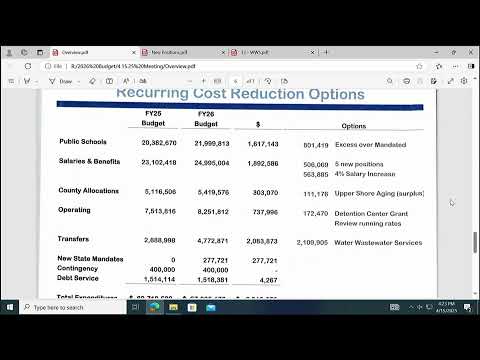
Staff recommended treating nonrecurring capital outlays with fund balance and lease proceeds while eliminating about $1.5 million from recurring spending to restore a balanced operating budget. The commissioners discussed three principal ways to close the recurring gap: spending reductions (targeting operating budgets, new positions and county allocations), a modest increase in the county income tax rate (from 3.2% to 3.3% under recently passed state enabling legislation), and additional increases in water/wastewater user rates.
“On the revenue side, nothing has changed — we still have that $2.3 million of available discretionary revenue,” a county budget presenter said. “If we pay for everything in the proposed book, we would reduce fund balance by about $6.08 million.”
Why it matters: Commissioners were explicit that one-time fund balance should not be used to cover recurring obligations. Staff’s analysis separates recurring and nonrecurring items: if the county pays cash for all capital and one-time requests it projects a healthy nonrecurring ending balance, but recurring operations would end the year with an approximate $1.5 million structural deficit unless the board cuts recurring costs or raises recurring revenue.
Key options discussed
- Income tax: Staff said a recently passed state income-tax bill would let Kent County increase its rate from 3.2% to 3.3%, producing an estimated $673,000 in additional annual revenue. Commissioners noted the change can be adopted for calendar-year 2025 only if notified to the State Tax office by May 15; otherwise a July 1 notice would apply for tax year 2026. Staff emphasized the revenue would phase in over three years because of tax filing cycles.
- Water/wastewater rates: A 1% increase in user rates would generate about $46,470 annually; the draft budget already assumes a 4% increase this year (raising an average quarterly bill for a 12,000-gallon or smaller user from $354.12 to $367.68, or about $13.56). Commissioners discussed equity concerns because rate increases fall hardest on low-income and rural customers.
- Operating reductions and targeted cuts: Staff identified likely recurring savings in operating budgets, county allocations (notably Upper Shore Aging and the health department), and new positions (school and county). County staff estimated they could find $50,000–$100,000 from running-rate adjustments in operating lines and flagged vacancies and contract alternatives as near-term levers.
Board direction and next steps
Commissioners directed staff to: (1) continue work on operating-level reductions and return with suggested cuts; (2) check whether specific water/wastewater capital items can be delayed for a year; (3) hold a closed session to review a handful of personnel salary requests; (4) invite Kent County Public Schools Superintendent to present a preliminary budget after the Board of Education’s May 5 work session; and (5) ask Dan Mattson (capital projects) and Jim Miller (benefits/health) to attend follow-up meetings. Staff also noted the board could choose to consider the county income-tax option before the July 1 deadline for tax year 2026.