Get Full Government Meeting Transcripts, Videos, & Alerts Forever!
Get email alerts on the Council Rules Public Participation topic
No spam. Unsubscribe anytime.
Hilliard council discusses wide-ranging edits to meeting rules, tables public-comment cap pending research
Summary
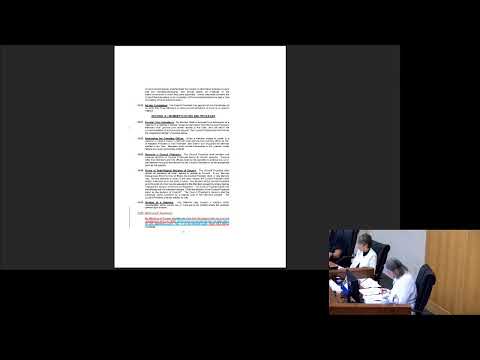
Hilliard City Council reviewed proposed edits to its council rules covering recusal and abstention language, motions, public participation limits and audiovisual displays, applicant lists for boards, and gift guidance; council deferred a final decision on public-comment time limits and directed staff to research peer cities.
HILLIARD, Ohio — Hilliard City Council members spent the meeting reviewing proposed amendments to the council rules that would clarify procedures for recusal and abstention, tighten language on motions, set procedures for retaining applicant lists for boards and commissions, and update guidance on gifts and public presentations. Council members agreed to remove a rule on ex parte contacts in quasi‑judicial proceedings and tabled a final decision on limits for public comment while staff researches how other jurisdictions handle time limits and visual presentations.
The proposed changes seek to tighten language across several sections of the rules, including specifying when motions require a second and a majority of members present, clarifying how postponements and amendments are handled and preserving current practice that council votes on amendments first and on the amended ordinance or resolution afterward.
Council members said recusal language is acceptable as written but asked staff to confirm whether the phrasing on abstention should reference the five or six reasons listed in Robert's Rules of Order and to check how those reasons intersect with Ohio ethics law. Staff was asked to provide the relevant Robert's Rules citations before the rules are finalized.
Discussion focused most sharply on the public participation section. The rules currently give each speaker three minutes; the draft adds a process by which additional time — often proposed as up to five extra minutes — may be granted by the council president or by a roll-call vote of members present. Several council members opposed a strict cap and argued for flexibility; others raised equity concerns about treating speakers consistently and suggested increments of five minutes or leaving final decisions to the presiding officer with the option for a floor vote. Council directed staff to survey five to 10 comparable municipalities and return with recommended language and practices on time limits and on whether and how members of the public can submit PowerPoint or other visual materials in advance for placement in the meeting packet.
On audiovisual materials, staff and council members raised security concerns about allowing members of the public to plug personal devices into city systems and discussed alternatives such as receiving files in advance for inclusion in the packet. Resident Heather Rickley, who identified herself and provided a local address, urged the council to allow public presenters to use the screen when helpful, citing equity and varied learning styles; council members said they would consider a submission deadline and methods that avoid security risks.
Council also agreed to retain applicant lists of candidates for Planning and Zoning Commission and Board of Zoning Appeals vacancies for a set period (a 90‑day example was discussed) so council can return to a recent pool of applicants if an appointee declines or resigns shortly after appointment. Members voiced support for that change during the discussion.
On gifts and ethics, staff explained the Ohio Ethics Commission has not adopted a specific dollar threshold for acceptability; advisory opinions distinguish between small items (for example, an inexpensive coffee) and higher‑value items or meals, but the commission has not settled on a fixed number. Council members noted the difficulty of setting a bright‑line dollar figure and said they would rely on the Ethics Commission's guidance and advisory opinions.
Procedural edits to motions were discussed and generally accepted in principle: clarifying that a motion not seconded is not considered and that council is not limited to the motions listed in the section. Council clarified that some actions still require specific supermajority thresholds (for example, convening executive session when quorum rules apply) and retained current references to those statutory or rule-based thresholds.
Council voiced consensus to remove language in Rule 13-6 that would limit outside contacts in some contexts, with staff and the law director noting that Planning and Zoning and BZA proceedings differ from legislative actions and that limiting outside contacts for council could raise First Amendment concerns in purely legislative matters.
By the end of the meeting council members agreed to several directions to staff rather than finalizing the full rules package: verify the Robert's Rules citations about abstention, compile peer-city public-comment procedures and examples of audiovisual submission processes, and return a final draft that reconciles cross-references (for example, removing second-reading language from the public-participation section where it duplicates Rule 6-06). The meeting adjourned by voice vote after a motion and second.
The council did not take a roll-call recorded vote on the council rules package at this meeting; members approved or accepted specific wording changes by consensus on several items and directed staff to return with additional research and a final draft.