Get Full Government Meeting Transcripts, Videos, & Alerts Forever!
Get email alerts on the Superintendent Candidate topic
No spam. Unsubscribe anytime.
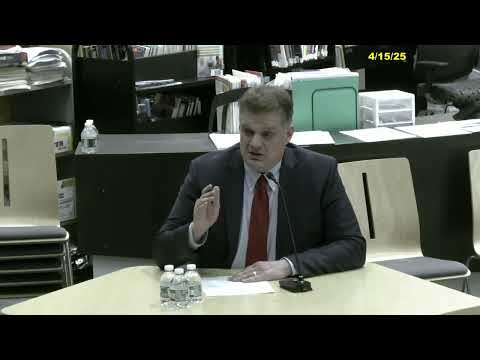
Peter Cushing outlines priorities for Beverly Public Schools in committee interview
Summary
Superintendent finalist Peter Cushing told the Beverly School Committee he would prioritize community engagement, teacher support, stronger tier‑1 instruction, and infrastructure upgrades including HVAC and solar projects; the meeting concluded with the committee adjourning after the candidate’s closing remarks.
Peter Cushing, a finalist for superintendent of Beverly Public Schools and currently serving in district leadership in Medford, presented his entry plan and answered a series of questions from the Beverly School Committee in a public interview session.
Cushing opened by describing his visit to Beverly schools earlier in the day and said he had prepared an entry plan with three phases for learning the district and soliciting community input. "We should almost see it as a reopening, a reinvigorating of our school district," he said, listing forums, listening sessions, translation services and on‑the‑ground outreach—coffee hours, evening desserts, and visits to neighborhoods—as ways to increase participation from families who do not typically engage.
He told committee members he would prioritize protecting classroom instruction and supporting teachers with sustained professional development, time to co‑plan, and measures to reduce burnout. He described concrete recruitment ideas including high‑school internships to build a local pipeline, partnerships with nearby universities, and backing certification programs (he named Orton‑Gillingham and Wilson reading as examples). "When the district is there to support them as a true partner, we can be successful in maintaining and recruiting," Cushing said.
On labor relations and rebuilding trust after a teacher strike, Cushing proposed a joint labor‑management committee (JLMC) to address problems early, frequent, transparent communication, visible district leadership presence in schools and better grievance handling. He said the district should perform a comprehensive needs assessment to clarify full staffing costs ahead of negotiations and to support bargaining with data tied to student work and outcomes.
Cushing described approaches to student safety and discipline that emphasize updated policy, tracking and restorative practices. He said his teams had rewritten bullying reporting forms, implemented tracking in Google Forms, reduced suspensions through alternatives to exclusion, and employed restorative justice partners. He stressed check‑ins and safety plans for targets of aggression and noted that physical assaults should trigger nurse checks.
On curriculum and instruction, Cushing emphasized strong tier‑1 instruction to reduce the need for costly interventions, wider access to AP and college‑preparatory opportunities, universal PSAT testing in grades 10–11 to identify AP potential, and explicit instruction in executive functioning, digital citizenship and critical thinking. He said early literacy (reading on grade level by third grade) is a priority.
Responding to questions about budgeting, Cushing said he favors a needs‑based budgeting process informed by periodic zero‑based reviews and by bringing department heads into budget planning. He criticized the state Chapter 70 funding formula as underfunding minimum‑supported districts and described advocacy work he has done at the state level. He also urged transparent communications to voters when the district seeks additional resources.
On facilities and sustainability, Cushing described work in Medford, including a recently approved bond for an HVAC replacement project he placed at $31,000,000 and described expected National Grid reimbursements of about $2,400,000. He discussed R‑22 refrigerant being effectively banned for production and the resulting replacement costs, solar arrays and efforts to electrify buses with state/federal grants, and noted the complexity and upfront cost of electrifying kitchens and hot water systems.
On technology, he said Medford is doing a two‑year network rebuild and that Beverly should assess its infrastructure with principal, curriculum and IT staff and community volunteers. He supports the "Wait Until Eighth" campaign for personal devices, digital literacy standards and library media specialists at all levels. He also described using E‑Rate to offset network costs and his decision in Medford to provide MacBooks for staff on a renewal cycle to ensure reliable instructional devices.
On civil‑rights issues and diversity, equity and inclusion, Cushing cited three past examples: de‑emphasizing an Indian warrior head mascot at Narragansett in response to local Native community concerns (later resolved by student advocacy), implementing DESE guidance for gender nonconforming students, and defending a student Gay‑Straight Alliance despite pushback. He said leaders must sometimes take unpopular stands to protect vulnerable students and staff.
The committee closed the interview and moved to adjourn. A motion to adjourn was made by Lorinda Visnick, seconded (speaker not recorded), and the chair declared the meeting adjourned at 9:07 p.m.; the committee said it will meet next on Thursday at 6:30 p.m.
The session covered Cushing’s plans and past examples rather than producing hiring decisions; the committee did not vote on personnel at this meeting.