Get Full Government Meeting Transcripts, Videos, & Alerts Forever!
Get email alerts on the District Budget topic
No spam. Unsubscribe anytime.
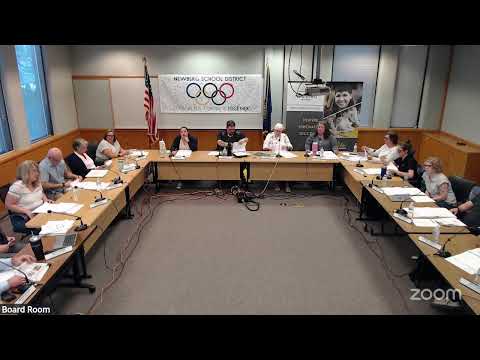
Newberg SD 29J budget committee hears proposed 2025–26 budget; committee elects chair and vice chair
Summary
The Newberg SD 29J budget committee received a proposed 2025–26 budget that preserves core services while relying on state assumptions and legislature action, and elected Kim Mihailov as chair and Claire Hertz as vice chair.
The Newberg SD 29J Budget Committee on Tuesday received a proposed 2025–26 budget that Superintendent Dave Parker said “represents a focused effort by district leadership to bring stability and clarity” after a year of organizational disruption and financial reductions.
The committee also elected Kim Mihailov as budget committee chair and Claire Hertz as vice chair; both nominations were seconded and the committee voted unanimously on each motion.
The budget presentation emphasized three constraints shaping next year’s plan: declining enrollment, higher fixed costs (including rising PERS employer contribution rates and insurance), and uncertainty pending the Legislature’s final school-funding decisions. Parker said the district is using the governor’s proposed state-school-fund numbers as the working assumption but cautioned that the governor’s recommendation does not fully cover the district’s rising costs.
Parker, the superintendent, told the committee the document before members is a proposed framework rather than a final, error-free ledger. Claire Hertz, a budget committee member who opened the meeting, said, “the document that’s in front of you is wrong,” and that staff would continue reconciling and correcting items before formal adoption.
Key figures and assumptions in the presentation included a total all-funds activity figure of $104,070,512; a beginning general-fund balance projected at $850,000; and an assumed 4 percent local property-tax growth for revenue estimates. The superintendent and finance staff said the district is budgeting conservatively on the governor’s proposal (which they described as a roughly 10.5 percent statewide increase in the State School Fund) but expects the district’s State School Fund allocation to rise by about 4 percent.
The budget relies on some one-time and contingent items: the packet includes an assumption that a state action (discussed as Senate Bill 867 to buy down PERS rates) would be enacted in time to reduce the district’s pension-cost increase; district staff said they budgeted on that buy-down passing. Parker said the district also is accounting for a PERS-related rate credit produced by a prior district bond; that credit will decline over time and the PERS bond matures in February 2028.
Staff identified operating pressures that were not previously budgeted, including nearly $700,000 of utility and other underbudgeted expenses and a $125,000 copier lease; liability and workers’ compensation increases estimated at about $200,000; and curriculum needs the presentation placed at “over a million dollars” while pointing out the current curriculum account was cut to $19,000 last year.
On personnel and service-level decisions, the proposed budget is built on six furlough days (down from eight in the current year) and includes several targeted staffing changes: district staff said three licensed positions and three classified positions (plus an estimated 1.5 FTE tied to enrollment declines) were identified for reduction as part of balancing. The district plans to restore two counselor FTE by shifting Student Investment Account (SIA) funds to make counselors full-time rather than split halftime positions. Parker said staffing specifics remain subject to personnel and bargaining processes and that reductions in the proposed budget are placeholders until actual HR actions occur.
The committee heard details about restricted funds and capital planning: special revenues were restructured so many previously pooled grants are now in separate funds; the 2021 general obligation bond fund remains active as projects wind down; and the district expects a principal payment of about $3.5 million tied to the Dundee property loan that comes due in June 2026. Staff said proceeds from a possible sale of the Dundee property would be used to cover the payment, or the district would pursue other financing if the sale did not close in time.
Transportation costs were raised: the district’s contract with First Student includes scheduled increases (the presenter said a roughly 4.5 percent contractual uplift), and committee members asked for a breakout of multiyear and year-to-year purchased services. School safety officers are funded through the SIA account, staff said. Several members asked for follow-up detail on substitute costs, special-education cost pressures (including how the district is addressing maintenance-of-effort requirements), FTE counts for 2024–25 in practice versus last year’s adopted budget, and a clearer list of positions cut last year versus positions currently in place.
Finance staff told the committee discretionary building-level funds will be budgeted at the full amount but initially restricted to 80 percent spending until district leadership lifts the restriction. Members asked for explicit documentation of the assumptions embedded in the proposed budget (for example, the number of furlough days and the ADM used to calculate state funding); staff agreed to return with those reconciliations and other requested data at the next budget committee meeting on May 6.
No formal vote to adopt the proposed budget occurred; the meeting served as the official presentation and an opportunity for committee members to request follow-up information and clarifications ahead of future action.