Get Full Government Meeting Transcripts, Videos, & Alerts Forever!
Get email alerts on the Automated Traffic Enforcement topic
No spam. Unsubscribe anytime.
Committee reviews automated traffic safety camera bill and $1.18M proviso lift for non‑school cameras
Summary
Seattle Transportation Committee heard SDOT and central staff presentations on proposed local code changes to align with 2024 state law, discussed equity, privacy, and warning/fine policy, and considered a separate proviso lift to spend $1,180,000 on non‑school automated speed cameras. No final vote was taken.
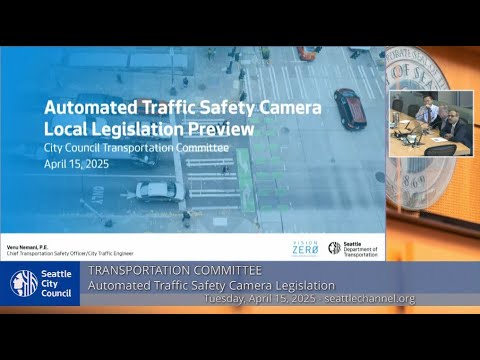
Seattle City Council members on the Transportation Committee on April 15 heard a presentation from the Seattle Department of Transportation and central staff on proposed local legislation to align city code with 2024 changes in Washington state law governing automated traffic safety cameras, and discussed a separate budget authorization to spend $1,180,000 of general fund money on non‑school speed cameras.
The legislation, presented by Vinnie Nemani, Chief Transportation Safety Officer and City Traffic Engineer with the Seattle Department of Transportation, would update Seattle Municipal Code to incorporate the state’s newly enumerated camera types, remove references to repealed “racing zone” cameras, require safety and equity siting analyses before placing or relocating cameras, and revise local provisions on signage, warnings and fines. Nemani said the city would publish updated implementation guidance after the ordinance is adopted.
Why it matters: Committee members and public commenters framed the changes as consequential for safety, equity and privacy. The state law sets a $145 maximum penalty for camera infractions and permits schools and certain work zones to be subject to higher amounts; the local changes would set Seattle fines below that cap except for school and certain work‑zone provisions and would consolidate most camera revenues into an Automated Traffic Camera Safety Fund to pay for program administration, camera installation and safety infrastructure projects.
Public commenters urged caution on fines and warning policies. Gordon Padelford, executive director of Seattle Neighborhood Greenways, told the committee that “we need to do it transparently, we need to do it in a fair way, and we need to do it effectively,” and urged written policies, first‑time warnings and reinvestment of revenues in site‑specific safety improvements. Clara Canter, an organizer with Whose Streets Are Streets?, argued the draft sets fines “3 to 5 times the level of other cities” and criticized repeal of the longstanding first‑offense warning practice and the pooling of revenues into a broad bucket rather than directing them to local safety fixes.
Ethan Campbell, identified as a Seattle cyclist and contributor to Vision Zero Network guidance, cited SDOT data and urged the committee to restore first‑violation warnings and to limit revenue uses, saying, “SDOT’s own data shows that warnings are 95 percent effective at preventing second violations.”
SDOT and central staff described specific code and administrative changes. Nemani and Bill Laborde of SDOT walked members through: (1) required updates to Title 11 (automated safety) to list allowable camera types and to add the equity and safety siting analysis; (2) changes to who may review and issue citations (adding trained civilian reviewers in SPD and SDOT, consistent with state law); (3) a proposed 30‑day warning period after activation for new camera locations except for school zones (the administration proposes repealing the separate “first violation” warning that SDOT previously issued); (4) an updated fine schedule that generally matches existing traffic penalty levels, while noting the state law cap and the state provision that allows doubling penalties in school and certain work zones; and (5) creation of an Automated Traffic Camera Safety Fund to replace the prior school‑safety fund so revenues (except certain red light camera portions) can be used across safety programs.
On privacy and data use, Nemani said city and state law limit use of camera images to traffic enforcement only, prohibit facial recognition, and restrict sharing. SDOT described deletion rules it follows: images associated only with warnings and rejected reviews are deleted 31 days after the determination; images tied to citations are retained for three years before deletion. Calvin (Cal) Chow of Council Central Staff said he will provide a forthcoming memo but noted the city’s surveillance ordinance exempts statutorily authorized traffic cameras and that consolidating camera revenues into one fund would shift some spending decisions from internal financial policy to the annual budget process.
Committee members asked about fine calculation, court capacity, accessibility of relief programs and how revenue will be spent. Council member Kettle asked how fine amounts were derived; SDOT and central staff explained the city historically treated camera penalties similarly to officer‑issued traffic fines and that some amounts (for block‑the‑box and restricted lane pilots) were set by prior state pilots. Members emphasized the need to ensure Seattle Municipal Court and Seattle Police Department have the resources to handle additional review and adjudication workload. SDOT said it will coordinate an interdepartmental approach to budgeting and to an annual evaluation process for deciding whether cameras should remain, be relocated or removed.
Separately, the committee reviewed a draft budget authorization (a “proviso lift”) prepared by central staff to allow spending of $1,180,000 in general fund dollars the council had earlier set aside for non‑school camera deployment. The document would lift a prior restriction and allow the executive to use the funds to install and begin operating non‑school full‑time speed cameras; SDOT staff said procurement, vendor work orders (administered by SPD) and physical constraints such as power availability will shape deployment timing. The proviso lift was presented and discussed; no committee vote was recorded at the April 15 meeting.
Next steps: Central staff said a formal council bill and a committee memo will be circulated for future consideration; SDOT expects to publish implementation guidance after the ordinance is passed. Committee members and staff signaled plans to return with more detail on court impacts, projected citation volumes at pilot sites and draft equity and privacy practices before any final council action.