Get Full Government Meeting Transcripts, Videos, & Alerts Forever!
Get email alerts on the Land Use Mbta topic
No spam. Unsubscribe anytime.
Old Colony Planning Council briefed school committee on MBTA Communities zoning; town must zone for capacity estimated at about 750 units
Summary
Jason Desrozier of the Old Colony Planning Council presented MBTA Communities zoning requirements to the East Bridgewater School Committee on April 15, saying the town must zone for roughly 750 housing units but that wetlands and ownership patterns limit near-term development.
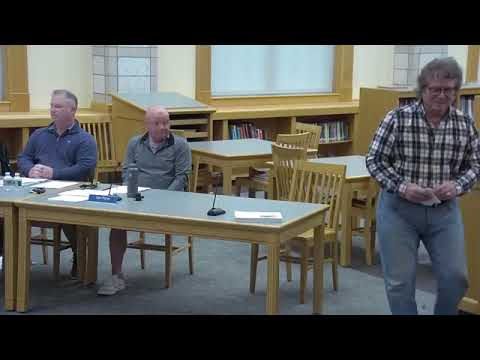
Old Colony Planning Council senior planner Jason Desrozier presented an overview of the state's MBTA Communities requirements and how they apply to East Bridgewater during the April 15 meeting.
Desrozier described MBTA Communities (referred to in the presentation as "3A," the new section added to Massachusetts' zoning statute Chapter 40A) as a zoning obligation, not a mandate that housing be built. "It's next slide. It's important to note the law, again, does not require that multifamily housing be built. The law only requires towns to zone for multifamily housing so that it can be built in select areas," he said. The requirement sets a minimum gross density of 15 dwelling units per acre and a minimum district size of 50 acres where the law applies.
Using the state's calculation method, Desrozier said East Bridgewater's capacity requirement under MBTA Communities is approximately 750 units, derived from taking 14% of the community's 2020 housing unit total. He emphasized that capacity is a zoning calculation and not a production target: the town could zone for the capacity without any new units being built.
Desrozier walked the committee through a proposed district in east-central East Bridgewater bounded roughly by Whitman to the north, Route 18 (Bedford Street) to the east and Winter Street to the west. He noted the draft carve-out includes 11 parcels; owners include NSTAR Electric, JSC Holdings (a recently approved 40B developer), Hornsby/Hornster Farms, and several private homeowners. He estimated substantial portions of the proposed district are wetlands or wetland buffer and therefore excluded from developable acreage, making short-term development unlikely on some owned parcels.
He also described the practical meaning of the density standard: "At the parcel level, the look of 15 units per acre will vary based on the parcel size. It could mean a 3 unit townhouse on a 10,000 square foot lot ... or a 45 unit building on a 3 acre parcel." He said the town is proposing bylaw heights of roughly 2.5 to 3.5 stories in the draft zoning.
Desrozier told the committee there will be a public forum on the topic on April 23 for a longer slideshow presentation and Q&A. He also noted that noncompliance carries potential consequences, including loss of eligibility for some state funding and, in theory, possible legal action by the Attorney General's office after the Massachusetts Supreme Judicial Court upheld the constitutionality of the MBTA Communities statute (noting the SJC decision in Commonwealth v. Town of Milton in the presentation).
What MBTA Communities means for East Bridgewater depends on the town's choices about district location, parcel carve-outs, and bylaw details, and Desrozier said that many constraints (wetlands, septic/water capacity, parcel ownership) make full build-out unlikely in the short term.