Get Full Government Meeting Transcripts, Videos, & Alerts Forever!
Get email alerts on the Public Safety Prosecution topic
No spam. Unsubscribe anytime.
Cape and Islands district attorney outlines new child-response team, trafficking work, fentanyl policy and elder-fraud push
Summary
District Attorney Robert Galloway told Barnstable County delegates the office has launched a child emergency response team, expanded human‑trafficking training with new grants, used a policy to hold fentanyl traffickers without bail and drafted a funding request to tackle rising elder fraud.
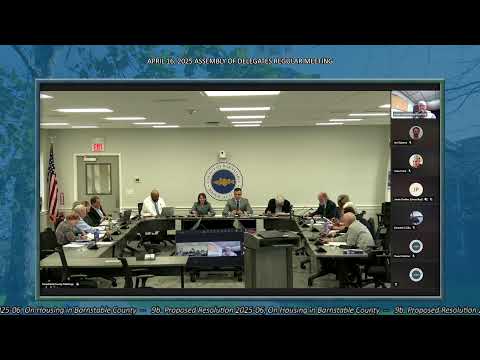
Robert Galloway, district attorney for the Cape and Islands, told the Barnstable County Assembly of Delegates on April 16 that his office has launched a multi-agency child emergency response team, expanded human‑trafficking work with state grant funding and is pursuing new resources to investigate elder fraud.
Galloway described the new CERT program as a cross-agency effort that notifies law enforcement, the Department of Children and Families and local victim services “so we can properly and thoroughly investigate” allegations affecting children. “Whenever we have instances when our most vulnerable victims, our children, are subject to a physical or sexual assault, in real time, all of the team members are notified,” Galloway said.
The nut of the office’s recent anti‑trafficking work is grant-funded training and a statewide conference, Galloway said. After a roughly $100,000 award last year that funded four trainings on Cape Cod, his office secured another $100,000 to host a two‑day statewide conference in Hyannis with nearly 200 attendees per day and 38 presenters from across the country. “We had 38 speakers, from across the country,” he said, adding that the U.S. attorney’s office participated.
Galloway also described a prosecutorial approach to fentanyl trafficking cases. Using a dangerousness statute, he said, his office has asked judges to hold defendants charged at trafficking levels without bail. He cautioned that he could not attribute causation but cited regional data showing declines: “In 2023, the numbers of nonfatals were down 10 percent, and fatals were down 7 percent. Now we got the 2024 numbers. Nonfatals are down 25 percent from 2023, and fatals are down 35 percent from 2023.”
On data-sharing and overdose response, Galloway said the office won a competitive funding package that will provide $1 million over four years to bolster SIMS, a regional critical-incident database used by police to log overdoses and share information with care providers. The funds, he said, will support a full‑time staff position, contracts with partner providers and expanded coverage for Martha’s Vineyard and Nantucket.
Galloway closed with a warning about elder fraud: police across the Cape reported an increase in cases and capacity challenges. He said Barnstable Police had 397 elder-fraud calls during his analyzed period and that 257 reports were filed; from those reports the office saw charges in 13 cases, roughly 5 percent. To address the problem, Galloway said he and his team drafted a budget request of about $580,000 to hire forensic examiners, additional prosecutors and victim-witness staff.
Delegates asked questions about courthouse detainers by Immigration and Customs Enforcement, the impact of artificial intelligence on scams, and outreach to hospitality and transit industries on trafficking awareness. About ICE detainers, Galloway cited the state Supreme Judicial Court decision Commonwealth v. Lunn and summarized its effect: because ICE detainers are civil, criminal courts and local law enforcement should not detain people in court on a civil process; by contrast, he warned, interfering with federal immigration enforcement can be a separate criminal offense.
Galloway declined to speculate on causal links between prosecution strategy and overdose trends but said the early results were “encouraging.” He thanked delegates for time and said staff would provide follow-up information as requests developed.
Ending: The district attorney’s report concentrated on prosecutorial tools and interagency programs that his office said are already active or launching; delegates pressed for more data on outcomes and welcomed further briefings as new staff and grant-funded positions come online.