Get Full Government Meeting Transcripts, Videos, & Alerts Forever!
Get email alerts on the Public Safety topic
No spam. Unsubscribe anytime.
Auburn Police report 2024: calls for service 20,758; overall crime declines, response times under industry targets
Summary
Police Chief Brian Morrison reported a year‑over‑year drop in most crime categories in 2024, rapid average response times for emergency calls, expansion of ALPR cameras and new Axon body cameras, and continued focus on homelessness outreach and school resource officers.
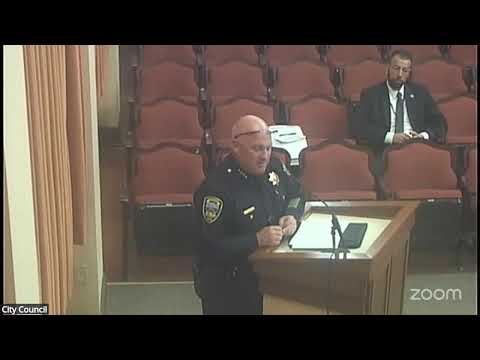
Police Chief Brian Morrison told the council that the Auburn Police Department saw an overall decrease in crime in 2024, while responding quickly to emergencies and increasing community engagement.
“Through their tireless efforts, unwavering dedication, to serve the community of Auburn, we all experienced an overall decrease in crime while, increasing community interactions,” Chief Morrison said as he opened the 2024 annual report.
Morrison said the department handled 20,758 calls for service in 2024. Dispatchers and records staff together handled approximately 27,444 total calls, including 3,586 9‑1‑1 calls, according to the presentation. The department reported 1,243 criminal cases authored by staff in 2024. Chief Morrison presented year‑over‑year decreases in several categories: crimes against society (including DUIs and disorderly conduct) decreased about 59 percent in the reported metric referenced; crimes against property decreased about 41 percent; crimes against persons decreased about 17 percent. Arrest totals also declined: total arrests were down about 14 percent, felony arrests about 25 percent and misdemeanor arrests about 8 percent.
Morrison highlighted response‑time performance: average response to priority‑1 (emergency) calls was 4 minutes, 42 seconds from call entry to officer arrival; priority‑2 calls averaged 4 minutes, 56 seconds; and priority‑3 calls averaged 9 minutes, 17 seconds. He noted that these figures measure the full interval from call entry through dispatch and arrival.
The presentation reviewed department programs and investments: the records and dispatch teams completed roughly 847 public records requests and 1,700 case routings to the district attorney’s office; volunteers and reserves supported approximately 20 community events and helped collect nearly 946 pounds of prescription drugs in two take‑back events; 221 hours of foot patrols were recorded; and 2 school resource officers covered Placer High School, Evie Kane and Sky Ridge, with one SRO funded after a grant expiration.
On technology, Chief Morrison said the department replaced obsolete body cameras with Axon devices after securing grant funding, and installed automated license plate reader (ALPR) cameras through Flock Safety; ALPRs read about 19,000 plates in 2024 and contributed to multiple arrests of individuals associated with stolen vehicles and other investigations. The department also began a phased replacement of aging radio equipment to migrate onto the Placer County radio network; 4 portable radios were purchased with a Cal/OSHA grant award that Chief Morrison said totaled $45,000.
On homeless outreach and code enforcement, the chief credited Community Service Officer (CSO) Rhonda (referred to in the report as CSO Williams/Williamson in different slides) with proactively contacting people experiencing homelessness; the department reported 668 homelessness‑related incidents in 2024, of which 44 camps were cited or tagged for abatement. The department’s chronic‑homeless count reported in the presentation dropped from 26 (February 2023) to 19 (2024) and was reported as low as 14 in 2025 to date.
Council members praised response times and volunteers and asked follow‑up questions about traffic enforcement, school SRO staffing, radio replacement and use of camera systems. Chief Morrison noted limitations in dedicated traffic‑enforcement staffing — traffic enforcement is handled as an ancillary duty by patrol officers and directed monthly — and said the department would continue directed enforcement in collision hot spots such as Grass Valley Highway and El Dorado Street.
Council members also affirmed that station building repairs and replacement of radio and desktop equipment are being coordinated with the city manager for possible inclusion in capital and technology plans. The chief closed by recognizing staff awards and volunteers.
No formal action on department policy or budget was taken during the presentation; the report was received by the council and staff will follow up on infrastructure and equipment needs.