Get Full Government Meeting Transcripts, Videos, & Alerts Forever!
Get email alerts on the Municipal Finance Sewer topic
No spam. Unsubscribe anytime.
Council advances revised sewer fee plan after debate over large rate increases, lapsed CIP funds and bond risk
Summary
The council adopted Committee Report 106 and moved Bill 60 CD1 (sewer rate package) forward after lengthy debate about steep rate increases, lapsed capital and operating funds, and potential bond‑rating consequences.
The Honolulu City Council voted to adopt Committee Report 106 and advanced Bill 60 (2024), CD1, the revised sewer and wastewater rate package, to second reading after extended discussion about rate increases, lapsed funds and potential bond‑rating impacts.
Department of Environmental Services Director Roger Babcock and other administration officials described a fiscal plan that covers operation and maintenance, debt service and a capital program that includes the Sand Island refurbishment. Babcock explained the department proposed smoothing rate increases over ten years and that the package would begin in fiscal year 2026 to meet revenue requirements.
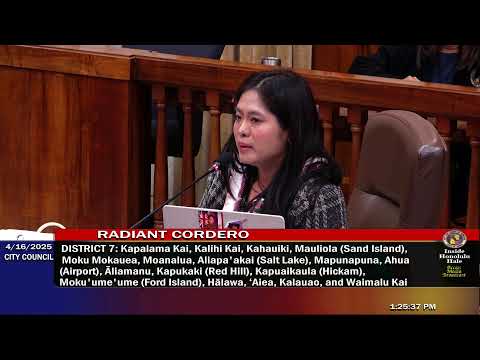
Council members repeatedly pressed the administration for alternatives that could reduce the rate burden on residents, particularly kupuna and low‑income households. Council Member Cordero questioned whether the administration could defer or reshape increases; Babcock responded that the city needs annual rate increases in coming years to meet scheduled debt service and capital obligations, although the timing and the smoothing of increases can be adjusted.
Administration and budget staff provided specific figures during the discussion. Council members were told the department’s operating budget had a historical lapse—between FY2019 and FY2024—of about $226,000,000 (roughly 12.39% of the operating budget), driven in part by unfilled positions; the capital improvement program had lapses totalling about $574,400,000, including roughly $135,400,000 of lapsed Sand Island project appropriations. Babcock said many capital lapses reflect project delays, contract issues or protests rather than money spent.
Several public testifiers urged the council to resist steep increases. Natalie Iwasa and Donald Sakamoto said increases would disproportionately harm residents on fixed incomes; others suggested using general fund rebates to mitigate impacts. Board of Water Supply staff requested at least three to six months lead time for any approved rate change so billing systems can be updated.
Council Member Weier, who authored a related bill to provide the administration flexibility for a fiscal stability fund, said the ordinance’s intent is to give the city the ability to respond to emergencies while preserving council oversight. Weier asked the administration to identify offsets the council could use to reduce the direct impact on ratepayers.
After discussion and recorded roll calls, the council adopted CR106 and passed Bill 60 CD1 to second reading. The clerk announced the vote on CR106 as eight ayes, one member absent. The subsequent roll-call on Bill 60 CD1 likewise recorded eight ayes with several members expressing reservations in committee notes. Members instructed departments to return to budget committee with options for offsets and to ensure adequate lead time for billing and implementation.
The package as presented aims to stabilize the sewer enterprise over the next decade by matching planned capital projects and debt service obligations with projected revenue, but council members signaled they expect continued work to reduce impacts on vulnerable residents.