Get Full Government Meeting Transcripts, Videos, & Alerts Forever!
Get email alerts on the Stormwater Infill topic
No spam. Unsubscribe anytime.
Nashville committee defers stormwater infill rule changes after code and scope questions
Summary
The Transportation & Infrastructure Committee deferred a resolution asking Metro Water to revise the stormwater management manual to address residential infill and tree credits. Councilmembers asked for legal and planning staff to clarify how the rules apply to multi-unit development before the item returns.
The Transportation & Infrastructure Committee of the Metropolitan Government of Nashville and Davidson County on Monday voted 9-0 to defer one meeting a resolution (RS 2025-11167) that would ask Metro Water Services to revise the stormwater management manual to address residential infill and tree-credit rules.
The resolution, sponsored by Councilmember Truffle, asked Metro Water and planning staff to update infill guidance and the manual’s treatment of trees and multifamily development. Truffle said the changes respond to larger homes and denser development that increase impervious cover and runoff, and noted that a single mature street tree can retain “5 to 6,000 gallons of water” for a 20-inch diameter trunk.
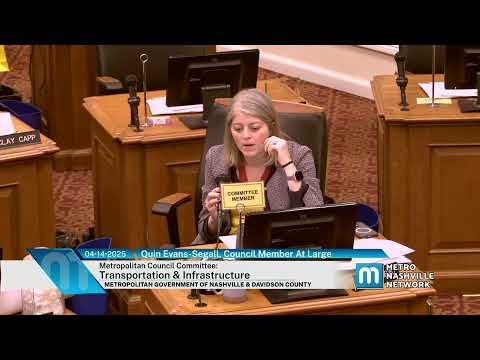
Councilmembers said they needed better alignment between the manual and current city code before approving revisions. Councilmember Evans Siegel questioned whether the manual’s residential-infill rules apply beyond one- and two-family dwellings; Metro Water staff replied that the current infill language was written for one- and two-family units and that recent development patterns — parcels under the grading-permit threshold producing three or more units — had exposed a gap. Steve Michoud of Metro Water Services said that the manual’s infill provisions were originally tailored "for one- to two-family dwelling units" and that the proposed update would close a loophole allowing some multi-unit projects to avoid infill regulation.
Councilmember Seacole pointed to an existing code provision (chapter 15.64) she said requires a grading permit for developments of three or more units, and asked staff to reconcile that section with the infill language. Seacole moved to defer the resolution one meeting so that Planning and Metro Water could meet the committee together and align the manual with the relevant code sections and the Housing and Neighborhoods Infrastructure (HNI) study; the motion passed 9-0.
Discussion vs. decision: the committee did not adopt the proposed manual revisions; members directed staff to return with Planning and Metro Water present to resolve how the infill manual language intersects with the stormwater code (chapter 15.64) and grading-permit thresholds.
Next steps: Metro Water and Planning were asked to appear at the next committee meeting to present the reconciled language and any relevant analysis from the HNI study. The committee’s deferral vote was recorded as 9 in favor, 0 against, 0 not voting.