Get Full Government Meeting Transcripts, Videos, & Alerts Forever!
Get email alerts on the Shorefront Ordinance topic
No spam. Unsubscribe anytime.
Planning Board reviews Shorefront Residential District ordinance updates, narrows redevelopment exemptions
Summary
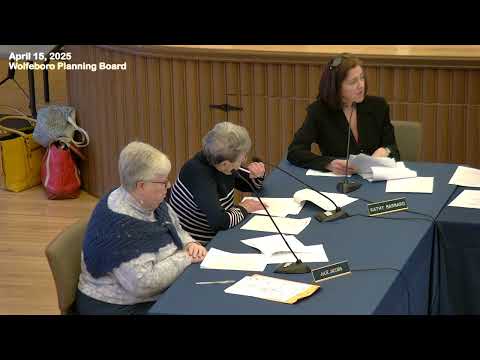
The Wolfeboro Planning Board reviewed redline revisions to the Shorefront Residential District ordinance on April 15, clarifying that reestablishment of the 50‑foot waterfront buffer and application of the natural woodlands buffer depend on a 20% impervious‑surface threshold and that redevelopment exemptions should be tied to whether impervious coverage increases.
The Wolfeboro Planning Board spent the bulk of its April 15 work session reviewing redline edits to the Shorefront Residential District ordinance, focusing on when waterfront and woodland buffer requirements apply and how to define "lot redevelopment." Shanna Saunders, the town's interim planner, walked the board through language tying reestablishment of the waterfront buffer to a 20% impervious‑surface threshold and proposed definitions and procedural requirements for redevelopment of lots within the shoreland zone.
The discussion centered on three interlocking issues: the 20% impervious cutoff that triggers reestablishing the 50‑foot waterfront buffer; whether buffer reestablishment language should specify the ordinance's tree‑and‑shrub point system; and how to define “lot redevelopment” so applicants and staff understand when exemptions apply.
Saunders said the draft ties the requirement to reestablish the waterfront buffer to projects that “result in more than 20% impervious surface coverage,” and that the ordinance text should explicitly require reestablishment to meet the point‑system criteria described elsewhere in the draft (25‑by‑50‑foot grids and a point scoring method for trees and qualifying shrubs). Board members pressed for clearer wording; one suggested replacing “reestablished” with “meet the point system described below” to avoid implying broad clearing followed by minimal replanting.
Board members also sought clarity about what plantings count in the tree score. Saunders confirmed that the reestablishment provisions in the 50‑foot buffer currently reference trees in the scoring table but that the ordinance also permits removal of shrubs over 3 feet high when a segment’s tree score exceeds the threshold, an issue several members called out as inconsistent and worth clarifying.
Members debated whether the natural woodlands buffer standards (the zone between 50 and 150 feet from the reference line) should apply only to new construction or to redevelopment where impervious coverage increases. Saunders’ draft made exemptions explicit: redevelopment lots with a preexisting nonconforming primary structure would be exempt from the Section B woodlands‑buffer standards if impervious coverage is not increased. Several members noted the current ordinance already references redevelopment of lots with preexisting nonconforming primary structures and suggested specific phrasing to mirror that standard.
The board discussed multiple options for what “redevelopment” might mean — from strict rules requiring preservation of existing footprints and foundations to looser approaches allowing movement of a footprint or substantial vertical expansion. The group indicated support for an approach that allows raising and rebuilding primary residential structures within the existing footprint, allows vertical expansion up to the ordinance’s height limits, and treats accessory structures consistently with the existing two‑accessory‑structure allowance, while preserving stricter limits for structures located in setbacks.
Randy (identified by Saunders as a remote commenter) clarified an important technical point: impervious‑area percentage calculations are drawn from 0 to 250 feet from the reference line for each lot (not from 0 to 150). Board members acknowledged that reference when discussing which standards are triggered by impervious thresholds.
Saunders said she would produce a revised draft reflecting the board’s wording preferences and then update the application form to mirror the ordinance language so applicants receive consistent guidance. She recommended keeping the ordinance changes as a work product for now and returning with a final draft for a future meeting.
Board members and staff identified additional drafting items: specify that the point score standard obligates replanting to meet the minimum points (not merely to “reestablish” vaguely), clarify whether shrubs and groundcovers should be included in the reestablishment scoring table, and state explicitly that if impervious coverage does not increase the lot is not required to prepare a professionally engineered stormwater management plan or to upgrade the natural woodlands buffer.
Saunders closed by saying she would provide a revised ordinance that incorporates the board’s direction and then update the application form to match the final wording, leaving formal adoption for a future meeting.