Get Full Government Meeting Transcripts, Videos, & Alerts Forever!
Get email alerts on the Balanced Budget topic
No spam. Unsubscribe anytime.
Subcommittee advances bills calling for Article V convention to propose balanced-budget amendment
Summary
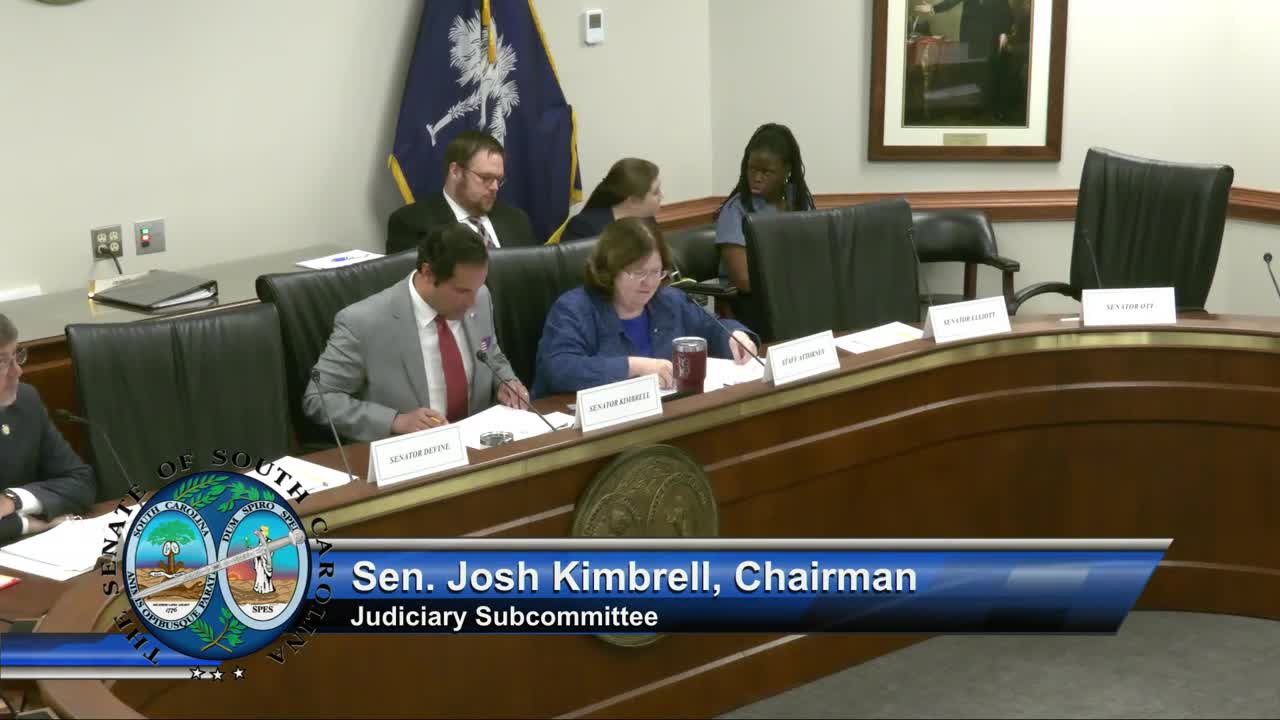
A Senate Judiciary subcommittee voted to report favorably on House Bill 3007 and Senate Bill 245, measures that would ask Congress to call a convention under Article V to propose a balanced-budget amendment limiting federal appropriations except in specified emergencies.
The Senate Judiciary subcommittee voted to report favorably on House Bill 3007 and Senate Bill 245, concurrent measures that would press for an Article V convention to propose a balanced-budget amendment that would limit federal appropriations when federal revenues fall short.
The measures were presented and discussed during a subcommittee meeting where Sen. Rice, sponsor of Senate Bill 245, urged colleagues to take the House bill "and not amend it so that we could get it across the finish line." Committee staff described the bills as restricting federal appropriations absent a qualifying national emergency and noted the House language would bar proposing amendments to the Bill of Rights or the 13th, 14th or 15th Amendments at any convention called under the bills.
The panel heard related testimony from Lauren Enns, who identified herself as national campaign director for Balanced Budget Now. Enns told the subcommittee: "The U.S. federal debt at $36,500,000,000,000 is a staggering 7 times federal revenue at just $5,000,000,000,000." She argued states should use Article V to pressure Congress to act and described the process by which states call a convention and Congress then proposes an amendment for ratification by the states.
Committee members asked procedural questions about the risk of a so-called "runaway" convention and how emergencies would be defined to allow temporary suspension of the amendment. Witnesses and staff told the subcommittee that a convention would be limited to the topic identified in state applications and that, under the Constitution, any proposed amendment would still require ratification by the states (38 required) before becoming effective. Enns said the bills would require a three-fifths vote of Congress to declare an emergency that could suspend the amendment, and she said existing presidential emergency declarations would not automatically qualify.
After questioning and public testimony, a motion to give both House Bill 3007 and Senate Bill 245 a favorable report to the full judiciary committee carried on a voice vote. The mover was recorded as "Mister Turner"; a second was recorded but not identified by name.
The measures now move to the full Senate Judiciary Committee for further consideration.