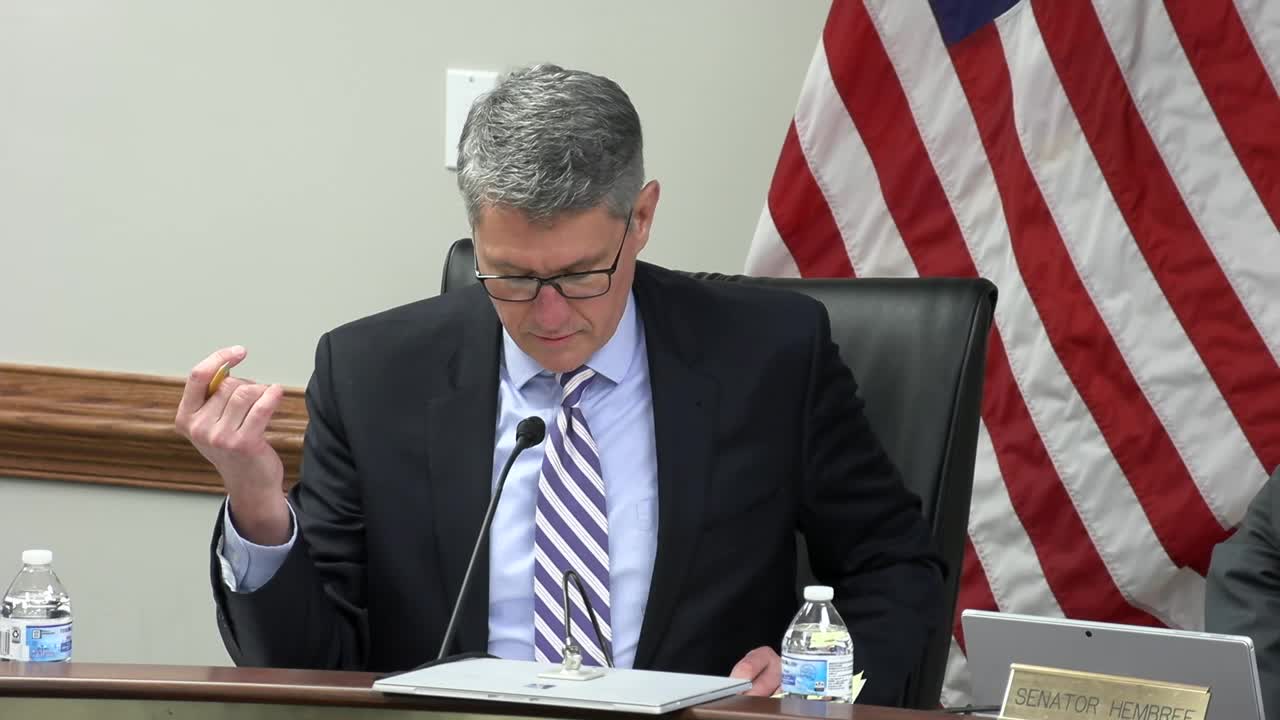
Senate subcommittee advances hands‑free distracted driving bill after amendments
Loading...
Summary
A Senate Transportation subcommittee gave H3276 a favorable report as amended after testimony on federal funding risks, enforcement language and DMV implementation concerns.
A subcommittee of the Senate Transportation Committee voted to give House Bill H3276 — the Hands‑Free and Distracted Driving Act — a favorable report as amended after hearing testimony about federal funding consequences, enforcement language and DMV implementation challenges.
The bill would prohibit holding or supporting a mobile electronic device while operating a vehicle and make reading, composing or transmitting text a violation. David Owens, staff to the committee, summarized the measure: "Bill H3276 prohibits the use of a mobile electronic device while operating a vehicle, provides exceptions as it establishes the offense of distracted driving and sets penalties." Owens also noted the bill's changes from prior years, including a new definition of "mobile electronic device," a one‑year delayed effective date and a provision that limits law enforcement stops for the offense.
The measure drew urgency from the Department of Motor Vehicles. Director Shwedo, appearing for DMV, warned the committee that the Federal Motor Carrier Safety Administration had made compliance a condition of federal highway funding and said the state risks losing $50 million this year and $100 million annually thereafter if it does not adopt a qualifying law. "This forcing function is the same other than it's 50,000,000 this year and a hundred million every year thereafter," Director Shwedo said. He also flagged an implementation concern: while the bill bars reporting the two‑point violation to insurers, the points still would appear on drivers' records and would be visible to anyone requesting that record.
Safety and enforcement groups supported the measure. Rick Todd, president and CEO of the South Carolina Trucking Association, said the association backs the bill and noted it is important to have a statute meeting federal criteria to protect commercial drivers. "The issue is DMV and DPS being able to transfer those records so that the federal government can pick up on it and they can act on CDL holder, disqualifications," Todd said. Michael Covington of Auto Club Group AAA emphasized traffic fatalities in the state and said distracted driving affects victims across age groups.
Key provisions discussed include a $100 fine for a first offense, $200 and two points for a second or subsequent offense, a 180‑day warning period for first citations after the law becomes effective, and a one‑year delay in the bill’s effective date after the governor signs it. The bill also instructs that law enforcement shall not stop, search or make a custodial arrest based solely on a distracted‑driving violation, language that was added on the House floor.
Senators debated enforcement standards; the panel adopted amendments to change a probable‑cause standard back to reasonable suspicion and to strike a paragraph barring insurer notification. There was no recorded roll‑call of individual votes; the chair announced the ayes carried the motions. The committee then voted to give H3276 a favorable report as amended.
The committee record shows the measure advanced with those amendments; the bill will move to the next legislative step with the amended language and the one‑year delayed effective date for implementation work at the DMV.
Votes at a glance: The subcommittee voted to adopt amendments (change to reasonable suspicion; strike insurer‑notification prohibition) and then voted to report H3276 favorably as amended. The meeting transcript records the chair saying, "That bill will receive a favorable report as amended."