Get Full Government Meeting Transcripts, Videos, & Alerts Forever!
Get email alerts on the Commercial Financing Disclosures topic
No spam. Unsubscribe anytime.
Senate subcommittee pauses consideration of Commercial Financing Disclosure Act after testimony
Summary
The Professions and Occupations Subcommittee heard testimony in support of Senate Bill 347, which would require standardized disclosures for commercial financing and restrict certain broker practices; members voted unanimously to carry the bill over for further work, including enforcement language.
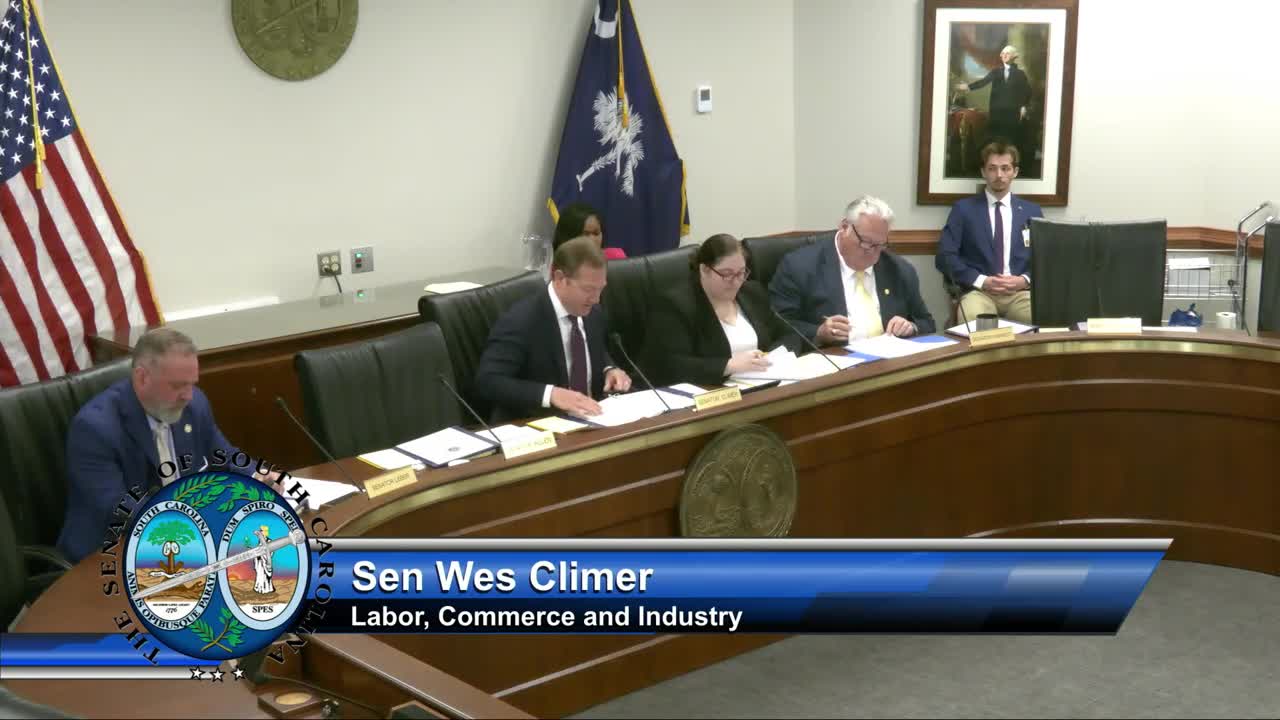
The Professions and Occupations Subcommittee of the Senate Labor and Commerce and Industry Committee heard testimony and carried over Senate Bill 347, the Commercial Financing Disclosure Act, after discussion about broker protections and enforcement.
Kate Fisher, partner at the law firm Hudson Cook and a representative of the Revenue Based Finance Coalition, testified in support of S.347, saying the bill would “standardize disclosure requirements” for nonbank commercial financing and create “common sense guardrails” for commercial financing brokers. Fisher told the panel that members of her coalition in South Carolina deploy about $20,000,000 in capital annually to roughly 1,000 businesses in the state and argued the bill would help small businesses compare different financing products by requiring disclosures such as the dollar amount the business will receive, upfront fees, total dollar cost of financing, the payment schedule and any prepayment penalties.
The bill’s broker provisions, Fisher said, would prohibit brokers from charging a fee to a small business before obtaining financing and would bar false or deceptive practices and misleading representations. She also described the disclosure format as similar in concept to the Truth in Lending Act disclosures for consumers, but tailored to commercial products.
Members pressed Fisher on several points. Senator Allen asked whether the proposed commercial disclosures resembled the Truth in Lending Act; Fisher replied they are similar in concept but designed for a broad spectrum of commercial financing products. A senator identifying himself as Aaron of Greenwood asked whether the measure is the same as the “Smart Box” model used in California and New York; Fisher said the bill is similar in concept to disclosure models adopted in Florida, Georgia, Missouri, Kansas and Utah but she had not given the disclosure format a specific brand name.
Committee members also pressed Fisher for examples of harms in South Carolina that the bill would remedy. Fisher said she did not have a specific South Carolina instance of brokers charging unlawful upfront fees at her fingertips but cited national trends where some responsible providers stopped offering capital after California and New York adopted stricter disclosure regimes. She said the bill seeks to preserve access to capital by establishing a state-level disclosure standard.
Members discussed enforcement. Fisher said stakeholders have had “a very productive dialogue with the Attorney General’s office” and that proponents were considering removing an enforcement provision that would have given enforcement authority to the Attorney General in favor of court-based remedies. During that exchange a committee member said it would be best to give parties time to work with the Attorney General’s office on enforcement language.
After questions and brief discussion among members about the need for state intervention and the risk of regulatory expansion, the subcommittee voted to carry the bill over for further consideration. A motion to carry over Senate Bill 347 was made by the senator from Charleston, seconded, and — with Senator Rickenbaugh recorded by proxy — the committee recorded a unanimous vote to carry the bill over.
The subcommittee did not adopt the measure or take final action; members said they want additional time to refine enforcement language and related drafting before returning the bill to committee.
Looking ahead, proponents and committee members indicated they expect further negotiation on enforcement language (whether to rely on court remedies or to retain AG enforcement) and on precise disclosure formatting. No implementation timeline or effective date was set during the hearing.