Get AI Briefings, Transcripts & Alerts on Local & National Government Meetings — Forever.
Senate committee hears accounts of alleged abuses in willed‑body market; Parker lays out bills to tighten consent, licensing
Loading...
Summary
Senate Bill 27 21 and a companion measure, Senate Bill 14 06, were heard in a full Committee on Health & Human Services hearing where witnesses described alleged abuses in the non‑transplant anatomical donation market and urged licensing, inspections and criminal penalties.
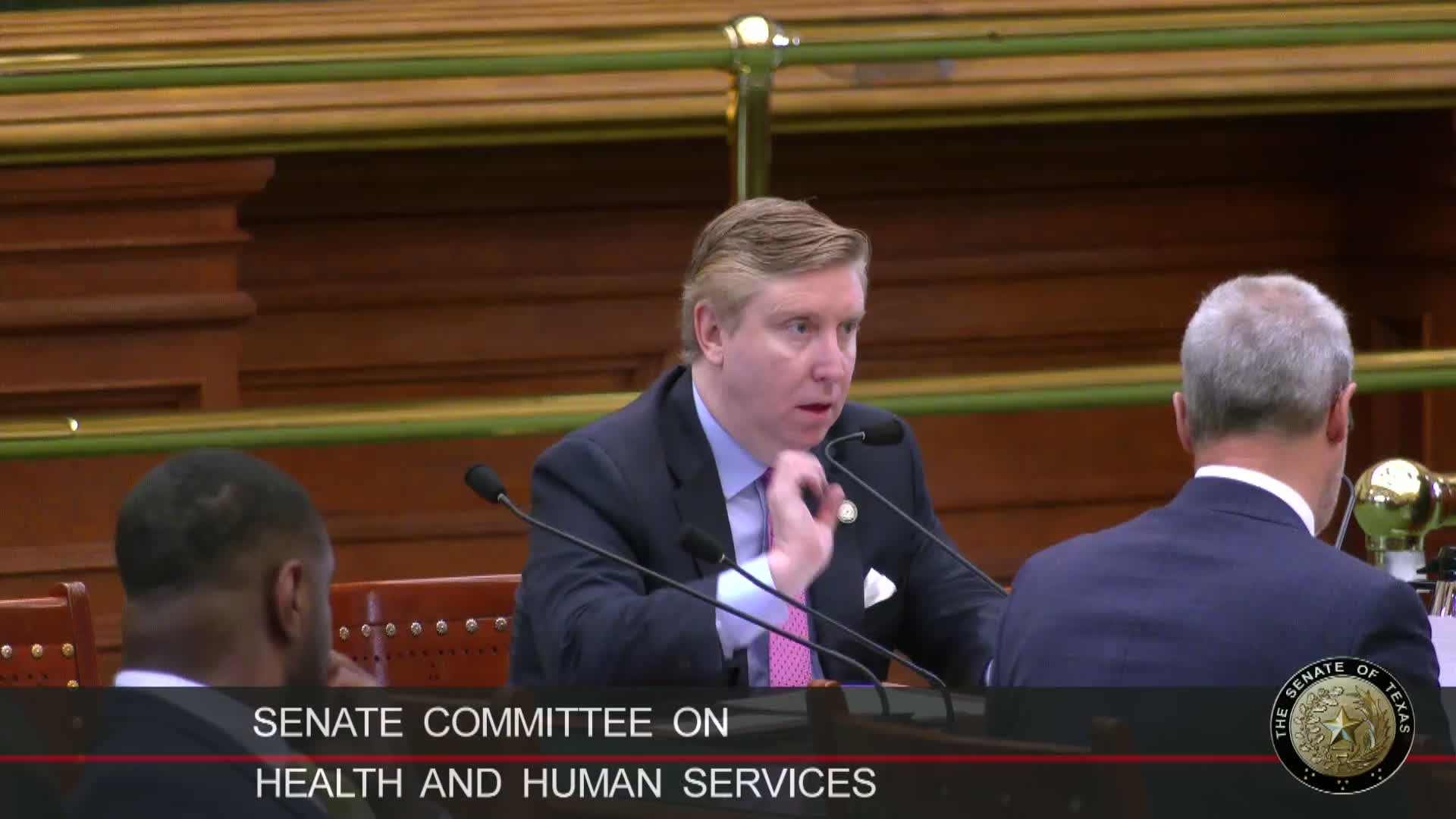
Senate Bill 27 21 and a companion bill, Senate Bill 14 06, were laid out together in the Senate Committee on Health & Human Services as legislators and witnesses described shocking abuses in the non‑transplant anatomical donation market and urged tougher state oversight and criminal penalties.
Senator Carol Parker, the bills’ author, told the committee that recent national and in‑state investigative reporting had uncovered “horrifying abuses” and that her substitute would “establish mandatory licensing for willed body programs and human body acquisition services. It institutes inspections. It demands transparency and accountability.” She said the substitute aims to create a “strict and stringent regulatory framework” to prevent exploitation of unclaimed or donated remains.
Parker described multiple investigative examples and specific cases discussed at the hearing. She told the committee that the University of North Texas Health Science Center had acquired more than 2,350 unclaimed bodies from Dallas and Tarrant Counties since February 2019, and she recounted several high‑profile family accounts of remains used without clear consent. Kimberly Patman, who identified herself as the ex‑wife of Victor Carl Honey, described the family's experience: “Victor's body was transferred to Dallas County medical examiner's office ... his body was then sent to the University of North Texas Science Center for medical research. Without our consent, Victor's body was dissected and sold for part.” Patman and other family members testified that parts were leased or sold and that the family later received ashes they could not verify as his.
Scott Bingaman, executive director of the Texas Funeral Service Commission, and Kristen Tibbs, the commission chair, described how NATOs formally entered the state in 2021 and said investigative complaints began surfacing thereafter. “They were given the authorization to be here 2 years ago,” Bingaman said, and he and Tibbs recounted examples investigation teams have documented — including bodies found poorly packaged or returned in unacceptable condition, and reports of body parts thawing in hotel bathtubs and other settings. Bingaman said a moratorium on import/export of human remains was imposed in April 2023 but that enforcement issues persisted.
Funeral commission leaders told the committee they had referred financial irregularities involving the former anatomical board to the State Auditor’s Office after obtaining banking records and identifying large, unexplained disbursements. Bingaman said he turned records over to the SAO and that the office “is proceeding with the investigation.”
Medical, academic and industry witnesses tested in both support of stronger rules and with cautions about unintended consequences. Dr. Mark Scott, chief medical officer for the city of Austin and faculty at UT Austin’s Dell Medical School, supported SB 14 06, saying it restores the primacy of informed consent and protects donor autonomy. Representatives of accredited whole‑body donor organizations (Science Care) and of licensed bioskills facilities urged careful drafting so that legitimate training and research would not be disrupted; Science Care leaders asked that recently enacted Senate Bill 2040 be allowed to be implemented and evaluated before additional statutory changes.
Metamarket and other anatomical facilities described the way accredited bioskills labs operate: secured, single‑purpose training facilities that accept only documented donor consignments, run didactic sessions, then perform hands‑on procedural training for clinicians and first responders. Metamarket’s CEO said the facility does not accept unclaimed bodies and that many training providers have been canceled because of a recent shortage of available specimens after the Funeral Commission and others tightened restrictions.
Committee members from both parties expressed shock at the testimony and urged strong penalties for bad actors. Senator Perry and Senator Hall said licensing alone may not be sufficient and advocated for statutory criminal penalties; Senator Hall said regulators’ prior experience leads the committee to consider more than just licensing and monitoring.
Public testimony included family members describing personal harm, researchers reporting on the prevalence of unclaimed bodies used in teaching, representatives of the Texas Hotel & Lodging Association and the Texas Catholic Conference of Bishops supporting stricter rules, and industry petitioners urging careful drafting to protect legitimate medical education.
The chair closed public testimony and left both Senate Bill 27 21 and Senate Bill 14 06 pending. She said committee staff and the sponsor would continue work on a substitute intended to center consent, licensure, inspections and strong enforcement, including criminal penalties, and that the committee would revisit the bills following rulemaking, stakeholder negotiation, and drafting of the substitute.