Get Full Government Meeting Transcripts, Videos, & Alerts Forever!
Get email alerts on the Public Comment topic
No spam. Unsubscribe anytime.
Conference committee accepts amendment and gives due pass to Senate Bill 2180, narrows public-comment scope
Summary
A conference committee accepted an amendment and recommended a due pass for Senate Bill 2180, which limits public comment at meetings of public entities to matters on the current meeting agenda or the immediately preceding meeting.
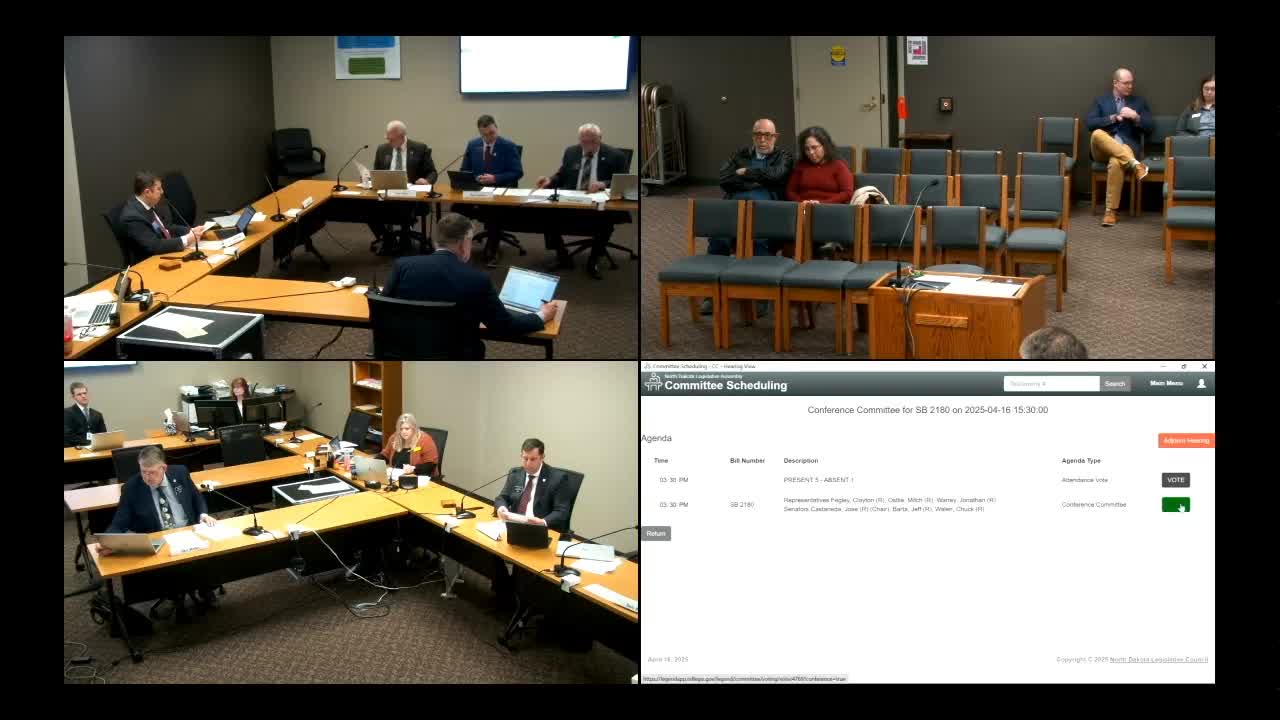
Chairman Castaneda convened the conference committee on Senate Bill 2180 and the panel accepted a committee amendment before giving the bill a "due pass" to be returned to the chambers.
The accepted amendment (committee proposal labeled 2003) narrows the scope of permitted public comment by allowing public entities to limit comment to matters that were on the agendas for the current meeting and at least one preceding meeting. Committee members described the change as a rewording and a single substantive addition that clarifies the temporal and topical limits on comment.
The bill’s short title was read into the record as relating to "the opportunity to provide public comment at a meeting of public entity." Committee discussion focused on how narrowly local governments, school boards and other public entities could draft their own policies within the bill’s limits. Chairman Castaneda said the 2003 amendment was the committee’s proposal and that it differs from the House amendment primarily by the added lines on page 2.
Supporters on the committee framed the amendment as a compromise that preserves residents’ ability to address recent agenda topics while preventing meetings from being derailed by unrelated or very old matters. Senator Wong, noting experience on a school board, said the provision to limit comment to the immediately preceding meeting was "a good compromise" because it keeps discussion pertinent and prevents going "into the weeds." Representative Voorhe moved the committee amendment; Senator Wallen seconded it. The amendment was accepted by recorded voice votes across the two delegations.
After accepting the amendment, the conference committee voted to give Senate Bill 2180 a due pass as amended. Representative Warren moved that the committee give a due pass to SB 2180 as amended; Senator Wallen seconded. The committee chair reported majorities on both the Senate and House sides and the bill was forwarded to each chamber with committee carriers assigned.
Committee members also discussed procedural details included in bill text and supporting materials: the amendment as described in committee pages rewords lines on page 1 for clarity and adds two lines on page 2 that impose the current-and-previous-meeting limit; the draft also includes standard provisions for local policies to set additional rules (for example, requiring a speaker’s name and address when signing up, as discussed during committee comment). The committee identified carriers for the bill: Senator Castile on the Senate side and Representative Osterly on the House side.
Formal roll calls recorded members saying "aye" on both the amendment and the final due-pass motion; the chair summarized that there were two affirmative Senate votes and three affirmative House votes on each measure, satisfying the committee’s majority requirements and preserving quorum.