Get Full Government Meeting Transcripts, Videos, & Alerts Forever!
Get email alerts on the Professional Licensing topic
No spam. Unsubscribe anytime.
Conference committee approves amendments to HB 1049 to restore subpoena power for speech‑language pathology board
Summary
A conference committee on House Bill 1049 voted to accept Senate amendments and attorney general office edits that restore statutory subpoena authority for the Speech‑Language Pathology and Audiology Licensing Board and make technical changes including removal of a "good moral character" phrase and transitional certificate language.
A conference committee on House Bill 1049 voted to accept Senate amendments and further edits from the attorney general’s office that restore statutory subpoena authority for the Speech‑Language Pathology and Audiology Licensing Board and make a handful of technical changes.
The changes, which the panel approved unanimously, remove a "good moral character" requirement from the bill, add language to include certain certificates issued before Aug. 1, 2026, and reinsert a disciplinary subsection that places subpoena authority into statute rather than relying solely on an administrative rule.
Assistant Attorney General Matt Menge, general counsel for the licensing board, told the committee the subpoena language is necessary for disciplinary investigations because the two primary employers of speech‑language pathologists and audiologists in the state — schools and hospitals — may decline to release records under FERPA or HIPAA. "Fortunately, a lawfully issued subpoena is ... an exception to both FERPA and HIPAA," Menge said, arguing that placing the authority in statute removes uncertainty about the board’s power to obtain records.
Menge said the board’s administrative rules already included subpoena language (citing administrative code chapter 11, section 11020302 subsection 4), but the attorney general’s office now reviews statutory authority more narrowly. "If this rule were to come before our office right now ... we probably wouldn't accept it," he said, so the committee moved the language into the Century Code section in the amendment package.
The committee also narrowed the scope of the subpoena language: the amendment strikes the word "witnesses" and now reads that the board "may subpoena and examine records, including client or patient records," rather than broadly authorizing subpoenas for witnesses, the transcript shows.
Committee members also discussed disciplinary tools that licensing boards may use when a licensee shows signs of substance use or mental‑health issues, including requiring physical or psychological examinations and the possibility of contracting with a Professional Health Program (PHP) to provide monitoring and treatment. Menge said boards have used mandatory evaluations sparingly: "In my 2 years, it's only been twice," he said, describing one case tied to relicensure after substance‑use concerns and another tied to criminal proceedings.
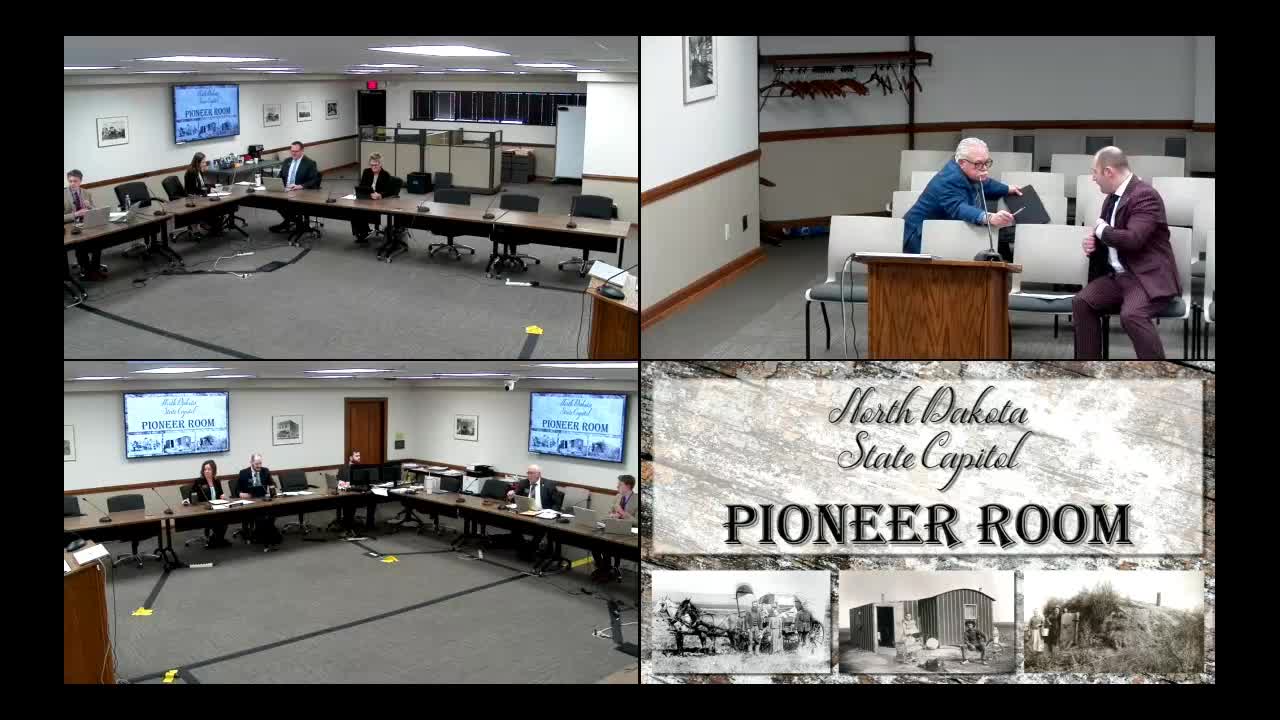
Representative Freigley moved that the committee accept the Senate amendments and the attorney general’s edits; Representative Hackman seconded the motion. The clerk called the roll and recorded unanimous support: Chairman Pagle (yes); Representative Hendricks (yes); Representative Freilich (yes); Senator Axman (yes); Senator Powers (yes); Senator Beauchetta (yes). The motion carried 6‑0‑0.
The amendment package also adds a clause recognizing certificates for speech‑language pathology professionals issued by the superintendent of public instruction before Aug. 1, 2026, to accommodate certificate holders who completed an earlier program. The transcript records that the Department of Public Instruction asked for that insertion to avoid excluding individuals who completed a prior certification pathway.
With the committee's approval, the revised statutory language will be included in the conference committee report for HB 1049 and carried forward by a bill carrier identified at the meeting.
Votes at a glance
- Motion to accept Senate amendments and attorney general office edits to HB 1049 — Moved by Representative Freigley; seconded by Representative Hackman. Vote: 6 yes, 0 no, 0 abstain. Outcome: approved.
Sources: Committee proceedings and remarks by Matt Menge, assistant attorney general and general counsel for the Speech‑Language Pathology and Audiology Licensing Board, as recorded in the meeting transcript.