Get Full Government Meeting Transcripts, Videos, & Alerts Forever!
Get email alerts on the Veterans Property Tax Relief topic
No spam. Unsubscribe anytime.
Senate committee hears plan to replace partial property tax exemptions for veterans with $1,750 credit
Summary
Supporters including county assessors told the Senate Committee on Finance and Revenue that Senate Bill 1094 would replace three partial assessed-value exemptions (active-duty military, disabled veterans, surviving spouses) with a uniform property tax credit intended to reduce administrative uncertainty caused by Department of Revenue remapping.
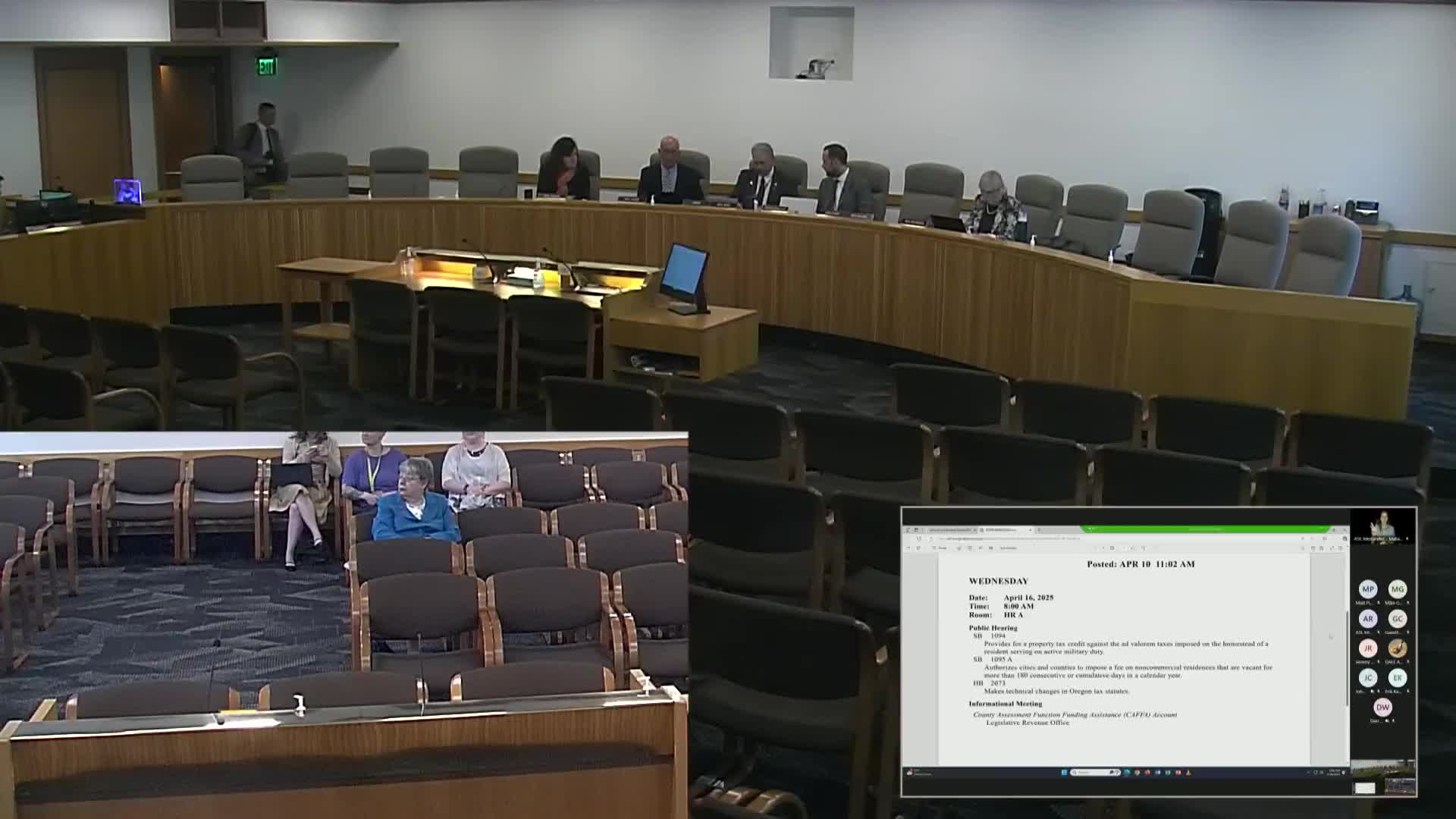
Senate Bill 1094 would replace three existing partial assessed-value property tax exemptions for active-duty military members, disabled veterans and surviving spouses with a uniform property tax credit of $1,750, supporters told the Senate Committee on Finance and Revenue during a public hearing April 16.
Proponents said the measure aims to remove administrative complexity created by recent Department of Revenue guidance requiring reassessment, commonly called “remapping,” when taxpayers enter or leave partial assessed-value exemptions.
Eric Chancellor, testifying on behalf of county assessors, said the bill “would phase those partial AV exemptions out and in their place establish, more uniform property tax credits.” He said the change would avoid the reassessment process that can sharply and unpredictably change a homeowner’s tax burden when an exemption ends. “That made the administrative process much more difficult for assessors, and it led to the exemptions being more uncertain and in a variety of regards inequitable to recipients,” Chancellor said.
Linn County Assessor Matt Pitcher said the current system is hard to explain to veterans and hard to predict in individual cases. “Our veterans want to know what they’re going to see, and we simply can’t answer that question the way it is currently,” Pitcher said, describing about 60 new applicants last year who wanted clearer outcomes.
Morrow County Assessor Mike Gorman gave a concrete example: after reviewing an active-duty service member’s timely application, he told the committee, he realized that after the service member’s deployment ended the taxable assessed value on the account “would almost double,” which could sharply increase the eventual tax bill. Gorman said the applicant withdrew her application after hearing that explanation; he told the committee that outcome runs counter to the intent of relief for service members.
Tax Fairness Oregon representative John Calhoun urged caution about the bill’s clarity. Calhoun said the bill appears to be “a technical bill affecting only a few hundred individuals” and recommended a legislative review after implementation to confirm it does not unintentionally broaden benefits or create loopholes.
Marcia Kelly of the Oregon Women’s Rights Coalition acknowledged the goal of simplifying administration but questioned equity of a flat credit. “If you have a flat amount that goes out at $1,750 … that’s a different percentage of relief from one veteran to another depending upon where they live and the value of their home,” Kelly said, urging consideration of a percentage-based approach.
Chair Meek and members noted the bill is a committee bill the Legislature has worked on in prior sessions; members said past efforts encountered constitutional and administrative obstacles. The hearing closed without a committee vote.
The bill’s sponsors and assessor witnesses said the measure seeks to restore predictability and make benefits uniform across qualifying residents, but some advocates urged monitoring after enactment and further consideration of benefit design.