Get Full Government Meeting Transcripts, Videos, & Alerts Forever!
Get email alerts on the Short Term Rentals topic
No spam. Unsubscribe anytime.
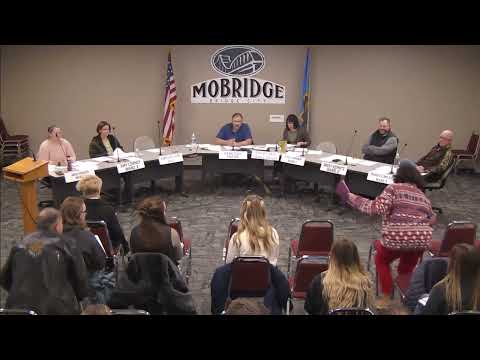
Mobridge council rejects short-term rental ordinance amid debate over owner-occupied units and licensing
Summary
The Mobridge City Council on Jan. 8 declined to adopt Ordinance 24-02, a short-term rental licensing ordinance, after public testimony and council debate over whether owner-occupied rentals should be covered, the proposed 25-license cap and inspection and fee requirements.
Mobridge City Council on Jan. 8 voted down the second reading of Ordinance 24-02, a proposed short-term rental licensing ordinance, after more than an hour of public comment and council discussion over owner-occupied units, fees and enforcement. The motion to approve the ordinance as amended was moved by Councilmember Mound and seconded by Councilmember Carlson; the roll call resulted in two yes votes (Carlson, Kemnitz) and two no votes (Mound, Cerny), and the motion failed for lack of a majority.
The ordinance, as amended and read aloud by city staff, defined a short-term rental as “a short term rental in which a private property or structure is rented, leased or furnished in its entirety to the public on a daily or weekly basis for a charge and where the rented property or structure is not also occupied by an owner or manager during the time of rental.” Heather, city staff, read that definition during the hearing. Opponents and owners who testified said the language as written may exclude owner-occupied rentals such as accessory apartments or garage-converted units and asked whether those should count toward the proposed cap of 25 licenses.
Several residents and local operators spoke during the public hearing. The owner of the East Side Motel asked how many short-term rentals exist in Mobridge; Heather replied the city’s count, based on listings on Airbnb and Vrbo, is “probably 16 or 17.” Mary, who said she lives on the property that includes a rented apartment, said she had contacted the South Dakota Department of Health and was told her lodging would be handled as a bed-and-breakfast under state procedures. Mary asked whether the city would defer to the state definition or apply the city ordinance’s separate definitions.
Council members and members of the public raised practical and policy concerns: enforcement and who would monitor compliance, whether the license would be transferable on sale of a property, safety and liability for owner-occupied rentals that may lack egress windows or other required features, and the ordinance’s intended effect on housing availability. Heather explained the ordinance would require an annual city license, a copy of the state lodging license, evidence of insurance endorsement for short-term rental activity and contact information for a local manager; the annual application fee was to be set separately in the city’s rates and fee schedule.
Speakers cited examples from other South Dakota municipalities as context: some cities require only an initial inspection or a one-time fee, while others require annual licensing; Deadwood’s fee structure and Custer’s actions were mentioned as illustrative of different approaches. The transcript records that House Bill 1149, a 2024 state bill that would have limited municipal authority on short-term rentals, was introduced but “died in committee,” a fact cited by staff as part of the background for drafting a local ordinance.
Public commenters argued both that short-term rentals reduce long‑term housing stock and that owner-occupied rentals differ fundamentally from properties purchased and used solely for nightly rentals. One resident urged that owner-occupied accessory units be excluded from the 25-license cap, saying those units do not remove stand‑alone houses from the housing market. City staff noted a licensing approach gives the city “the legal teeth” to pursue penalties and court action if unlicensed short-term rentals proliferate.
The council did not adopt Ordinance 24-02 on second reading; no alternative motion to amend the measure was recorded during the meeting. The council may revisit the matter at a future meeting if members bring new amendments or staff returns with revised fee and definition language.