Get Full Government Meeting Transcripts, Videos, & Alerts Forever!
Get email alerts on the Urban Forestry topic
No spam. Unsubscribe anytime.
Marshfield forester warns of rising emerald ash borer losses; department outlines planting, removals and $25,000 grant
Summary
City forestry staff reported rising emerald ash borer activity across Marshfield, detailed planting and removal work this year and said the department received a $25,000 Urban Forester grant to replant sites, including 71 trees planned for four locations.
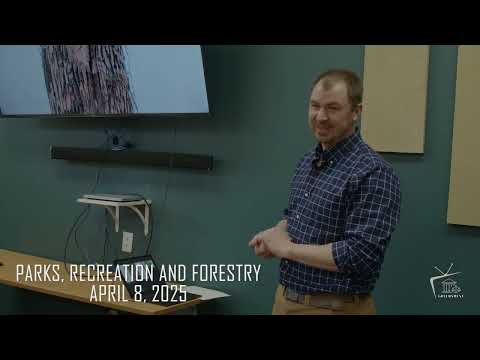
Mark, a Marshfield forestry staff member, told the Parks, Recreation and Forestry Committee on April 9 that emerald ash borer has become widespread across the city and that staff expect increasing ash mortality in coming years.
The update matters because the insect’s larvae destroy the tree’s vascular tissue and make infected ash brittle and hazardous in public areas. “The strength lost an infected ash tree, a 6 inch branch has a strength properties comparable to a healthy 1 inch branch,” Mark said, noting that sudden branch failures create high-risk conditions in parks and along streets.
Forestry staff said the department held an Arbor Day event with Grant Elementary School and planted about 40 trees at that event. Over the past year staff planted 116 street and park trees (roughly 1.5-inch caliper, 6–8 feet tall), pruned 268 trees during winter operations and removed 106 trees that staff determined to be in decline or hazardous. Staff described using a gravel-bed propagation method to grow many of the trees before planting to improve survivability.
The department described recent harvest and removal work at Brane Park, where crews chipped brush on-site, sectioned logs for auction and removed ash showing EAB damage. The committee heard that timber auctions from the Brane Park harvest sold in December and February and that the work aimed to stagger visual and use impacts by phasing removals across a five-year plan.
On funding, staff reported receiving a $25,000 Urban Forester grant that will be matched through in-kind labor and equipment. The grant-funded planting will place about 71 trees at four locations, including West Adler, South Central Avenue, East Veterans Parkway and Creasy Park; planting material will include ball-and-burlap specimens for salt-impacted street corridors. The department said the sites along major salt routes require hardier stock than the bare-root trees the city often grows.
Mark also said the city discontinued municipal injections for ash trees because of a budget cut; homeowners adjacent to public trees that had previously been injected were offered the option to hire private contractors to continue injections. “We are not injecting our ash trees anymore. That was a budget cut,” he said, adding that the city has notified affected homeowners about options.
Committee members asked staff to increase public education about EAB symptoms and treatment timing. Mark said the forestry web page contains resources and urged residents to contact an ISA-certified arborist in spring or early summer to determine whether treatment remains viable for specific trees.
The report concluded with an invitation to the committee to attend the annual Arbor Day planting on April 17 and described the department’s continued goal of planting more trees than it removes as it shifts to a more diverse urban canopy.