Get Full Government Meeting Transcripts, Videos, & Alerts Forever!
Get email alerts on the Child Welfare Reunification topic
No spam. Unsubscribe anytime.
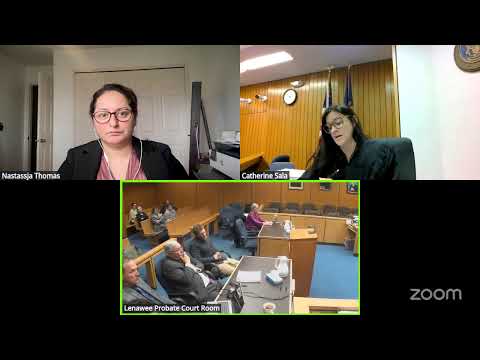
Judge continues reunification track after 90-day review; father criticized for lack of engagement, mother praised for sobriety and employment plans
Summary
A Lenawee County Probate & Juvenile Court judge continued the case’s reunification goal and the child’s placement with a rural relative after a 90-day review and permanency planning hearing, and scheduled a further review for July 8 at 11 a.m.
A Lenawee County Probate & Juvenile Court judge continued the case’s reunification goal and the child’s placement with a rural relative after a 90-day review and permanency planning hearing, and scheduled a further review for July 8 at 11 a.m.
The hearing focused on two parents: Christina Lemley, who the department’s worker and other witnesses said has sustained sobriety and recently accepted employment, and Matthew Wright, who the department said has been largely noncompliant with services and hard to reach. "I would say Matthew is noncompliant," Macey Moore, a foster-care worker with Catholic Charities, told the court during testimony.
The hearing matter began with a court report and attachments that included ICWA documentation, a nonmedical immunization waiver, a psychological evaluation, and a report of a missed DNA appointment for Mr. Wright. The department moved to admit the court report; there were no sustained objections recorded on the record and the report was placed in evidence.
Moore described Ms. Lemley’s engagement with treatment at Odyssey House and mental-health programming: she said Lemley has attended domestic-violence and mental-health groups, remains in random drug screening, and has been involved in outpatient therapy. Ms. Lemley told the court she begins orientation at Home Depot the day after the hearing and said the job offers "between 25 and 35 hours per week" at a starting wage she gave as "$16.50 an hour." She also said she has nearly 11 months of sobriety and a support network of recovery groups and coaches.
Ms. Lemley asked the court to allow a planned move to a friend’s residence, saying the new address is about half a mile from her current housing and that the friend was willing to allow CPS to inspect and review her home. She also said she had a release of information in place at Odyssey House so staff could discuss her progress with the department. "I have made a really massive, massive effort over the last couple months," Ms. Lemley told the court.
By contrast, staff and counsel described Mr. Wright as minimally engaged. Moore said she has attempted repeated contacts, including phone and Facebook Messenger, which she said Mr. Wright often reads without responding. Mr. Wright said transportation and lack of a driver’s license and car limit his ability to participate in services and attend appointments. "I begged and pleaded and basically gave $50 to get a ride today," Mr. Wright told the court when asked how he got to the hearing.
Attorneys and the guardian ad litem pressed both facts and context: Ira Nicole Underwood, lawyer guardian for the minor child, and Sasha Thomas, counsel for the department, urged the court to focus on outcomes for the child and to require DNA testing to verify paternity. Mr. Michael Brooks, attorney for Mr. Wright, described the geographic and transportation barriers his client faces and said they are difficult to overcome without additional resources.
In closing, the judge found the agency had made reasonable efforts toward reunification and thanked staff for securing the ICWA/BIA inquiry and the psychological evaluation. The judge said the court will continue to monitor whether Ms. Lemley can translate her sobriety and employment into stable housing and improved parent-child contact, and signaled concern about the effect of lengthy travel on the child’s experience of visits. The judge declined to bifurcate the case (placing one parent on a termination track while keeping reunification for the other), but indicated Mr. Wright would have another 90 days to show significant progress. "I do find the case, does have reasonable efforts towards the goal of reunification," the judge said on the record.
The court ordered that the child remain placed with the rural relative identified in the report and set the next permanency planning and review hearing for July 8 at 11 a.m.
Votes at a glance: the court admitted the department’s court report and attachments into the record and issued the procedural orders noted above; there were no formal recorded votes by ballot, only the judge’s rulings and scheduling decisions.