Get Full Government Meeting Transcripts, Videos, & Alerts Forever!
Get email alerts on the County Policy Update topic
No spam. Unsubscribe anytime.
King County councilmember warns homelessness rose sharply, defends keeping juvenile jail open
Summary
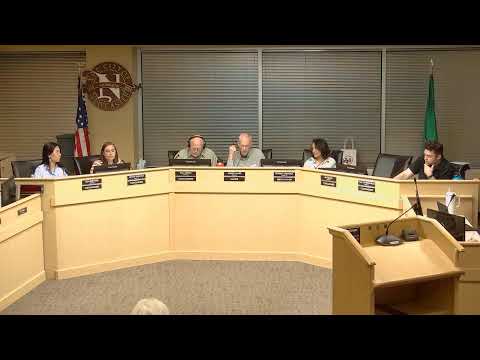
At an April 15 Newcastle City Council meeting, King County Councilmember Reagan Dunn summarized county data showing a rise in homelessness, outlined proposed budget cuts, and said the council voted unanimously to keep the county juvenile detention center open.
King County Councilmember Reagan Dunn told the Newcastle City Council on April 15 that homelessness in King County rose from about 11,000 to 16,000 people over roughly four years and that the county faces a roughly $150 million general-fund shortfall.
Dunn, who represents District 9, used the council’s meeting to outline recent county policy actions and survey data, describe public-safety and behavioral-health initiatives, and answer city council questions about local impacts and grant opportunities.
Dunn said the increase in homelessness, citing federal HUD data, shows Washington and Oregon were outliers in a national comparison of year‑to‑year changes. "We better start figuring out solutions to this," he said, urging local governments to expand housing and treatment capacity.
Dunn summarized several county actions and proposals. He said the county enacted a new Harborview Hospital tax last year to support operations and public-health clinics after an earlier bond and construction delays; he said he opposed that second tax even though he backed the initial bond. He also noted the council passed a minimum-wage ordinance that phases in higher pay through 2029 and beyond for unincorporated areas in King County.
On juvenile detention, Dunn said the county considered a proposal to close the juvenile detention center but the council passed his legislation to keep the facility open. "I moved legislation that passed unanimously to keep the youth jail open," he said, noting an 8‑0 council vote. He said the facility houses people charged with the most serious violent felonies and includes classrooms, a library and a gymnasium that support rehabilitation work.
Dunn described substance‑use disorder and overdose trends as a county public‑health crisis and advocated expanding treatment infrastructure and destigmatizing care. "Ninety percent of the public who are actively suffering from addiction will not get the treatment or help they need because they're afraid of the stigma," he said. He pointed to county actions that fund crisis‑care centers and public‑awareness campaigns and mentioned community organizations such as Recovery Cafe and Recovery Alliance Washington State as local resources.
Council members pressed Dunn on specifics. Council Member Scharke asked for municipal examples of effective local responses; Dunn suggested investing in more treatment clinics and said additional tools and funding — including potential federal behavioral‑health funds — could help. Council Member Burford thanked Dunn for county grants that benefited Newcastle, and Dunn highlighted a $9,250,000 grant that he said helped preserve the Milt Swanson property as open space in partnership with Bellevue and local groups.
Dunn also outlined county budget pressures. He said the executive proposed about $150 million in cuts to the general fund, including a roughly $30 million reduction in sheriff's‑office spending in the executive’s proposal. "We're gonna have to work hard in this biennial budget year to make sure that we do everything we can to reduce those kinds of cuts," Dunn said, arguing that emergency services are a top priority.
Other items Dunn raised included battery energy storage policies, efforts to address court backlogs and unlawful‑detainer cases after the pandemic, and county ballot measures: an EMS levy he helped craft that he described as revenue‑neutral over six years and a parks levy proposal to increase funding for parks programs and city grants.
Dunn encouraged Newcastle staff and residents to apply for county grant funding and offered his office’s help finding opportunities for local nonprofits and projects. He closed by answering additional council questions about staffing, juvenile crime trends and the county’s ongoing executive transition.
At the end of the presentation, Mayor Robert Clark and council members thanked Dunn for the report and for attending early on the agenda so he could leave before the meeting’s close.