Get Full Government Meeting Transcripts, Videos, & Alerts Forever!
Get email alerts on the Water Aquifer Protection topic
No spam. Unsubscribe anytime.
Council to ask voters whether Spokane should rejoin county aquifer protection area
Summary
City staff recommended placing a measure on the ballot this year to join the Spokane County Aquifer Protection Area; staff and advocates said the program would fund monitoring, education and infrastructure to protect the Spokane Valley–Rathdrum Prairie aquifer, while several residents raised questions about costs and local controls.
City leaders discussed a resolution to refer to voters a proposal for Spokane to rejoin the Spokane County Aquifer Protection Area, a county-administered program that charges parcel fees to fund aquifer monitoring, education and pollution-control projects.
Marlene Feist, city staff working on water issues, told the council "we have an opportunity this year to join the county's aquifer protection area" and said the current county authorization expires at the end of the year. She described how the program can charge fees per parcel and use revenues for education, planning, stormwater and wastewater projects and monitoring.
The measure would collect roughly $15 a year from most residential parcels connected to municipal sewer and drinking water service; Feist said the city would expect about $1,800,000 in annual revenue if Spokane joins. She told the council the county program has a 40‑year history and that the city was part of the original aquifer protection area but declined to participate when it was renewed in 2004. "These fees can pay for certain things like education around our aquifer and water source, preparation for, planning and project planning, construction of facilities, to protect the aquifer like for stormwater management, wastewater management, and for monitoring," Feist said.
Public commenters included residents and local water advocates. Catherine Thompson, speaking for Spokane Riverkeeper, said the aquifer and the Spokane River are connected and urged the council to give voters the chance to support continued regional protection: "By joining the APA, Spokane can take part in a regional strategy to safeguard the system from pollution and overuse. This APA can help prevent pollution, upgrade critical infrastructure, and support water conservation programs and public education," Thompson said.
Resident Larry Andrews questioned some technical points and emphasized that Spokane has abundant water, but he also said deeper wells might be needed in future. Another resident, Sherry Barnett, expressed concern about adding new layers of regulation and potential future taxes but said she trusted existing testing.
Council members who spoke said they would support placing the measure before voters. Council member Bingle called water "the single greatest resource we should be protecting" and said she favored asking voters directly. Council member McKechnart said he would ask for an annual report on how APA funds are spent so the public can see outcomes.
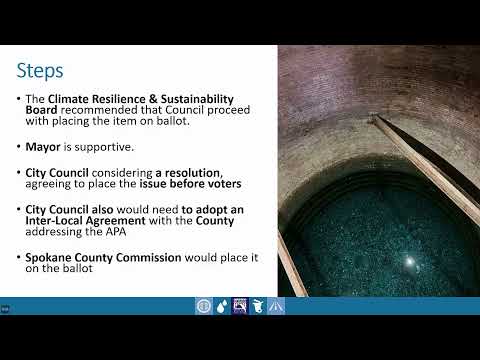
Council discussion also noted that, if voters approve, the city would need to adopt an interlocal agreement with Spokane County and that the county commission would place the measure on ballots for jurisdictions that join.
The council moved forward with placing the issue before voters; final implementation steps — including the interlocal agreement and the exact ballot language — were described as administrative steps that staff would complete after voter approval.
Why it matters: The Spokane Valley–Rathdrum Prairie aquifer is the region's primary drinking-water source. Supporters said regional funding helps long-term pollutant monitoring and local infrastructure projects that protect drinking water; some residents urged caution about new fees and powers.
What happens next: If the council-approved measure appears on the ballot and voters approve joining the county program, the city will negotiate an interlocal agreement with Spokane County to define fee collection, eligible projects and oversight. The council signaled support for asking voters to decide this year.