Get Full Government Meeting Transcripts, Videos, & Alerts Forever!
Get email alerts on the Unified Development Ordinance topic
No spam. Unsubscribe anytime.
Peachtree City planning committee unveils AI‑generated UDO outline, sets timeline and priorities
Summary
Chairman Hamner presented a Peachtree City‑adapted Unified Development Ordinance outline generated with AI from Fayetteville’s UDO and city ordinances, and the committee set a timeline through 2026 for completing the ordinance and advancing targeted “quick win” amendments.
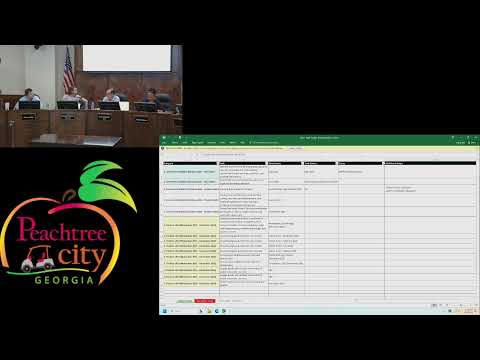
Chairman Hamner opened the steering committee’s discussion by presenting a completed, Peachtree City‑specific outline for a Unified Development Ordinance (UDO) that the committee said was produced using an AI tool and Fayetteville’s UDO as a foundation.
The outline, which Hamner said is “over a hundred pages” in its current form and includes Peachtree City‑specific sections drawn from ordinances available online, will remain a draft and is intended as a starting point for the committee’s work. A city staff member said the full ordinance will not be completed this year and the committee is aiming to finish the project by the end of 2026. The committee plans to update the City Council at the council’s second meeting in May, with a schedule of further updates through 2026 tied to draft milestones.
“The actual UDO is significantly bigger,” Hamner said, describing how the AI model was fed Fayetteville’s outline plus all Peachtree City ordinances the staff collected online. He said the tool organized chapters, provided subsection rationales and identified where Peachtree City‑specific language belonged.
City staff described how the working files are stored in a shared drive and confirmed an initial folder of existing zoning, land‑use, site‑development and building regulations is already being compiled. A staff speaker said the city’s zoning/code repository runs hundreds of pages; staff reported a working file “over 500 pages” used daily in the zoning office and said part of the committee’s work is organizing rather than removing provisions.
Committee members discussed outreach and transparency steps. Staff said a web page and an email address for the UDO project are being established and that the city clerk suggested an existing, widely used site on the city’s site would be a good location for posting materials and links to the working folder. Staff added there will be a public meeting schedule and that public hearings are required for zoning changes; zoning‑related items will come before the Planning Commission and then City Council for final action.
The committee discussed hiring consultants but indicated the consultant role would likely be narrower than in past efforts. Rather than paying a six‑figure fee to run public outreach and draft the entire UDO, the committee said it might use consultants for background legal and technical cleanup, reducing cost and timeline while retaining the steering committee as the primary reviewer before items go to council.
Committee members identified “quick wins” the group could move quickly through the normal public hearing process. Items discussed as candidates included a text amendment to address native plants and invasive species (anticipated by committee members to go before the Planning Commission in summer months and then city council), golf‑cart parking allowances or exchanges, bicycle parking requirements in overlay districts, and standards for EV or golf‑cart charging infrastructure. Members noted these measures still must follow public hearing requirements and be recommended by the Planning Commission before council consideration.
The committee approved the minutes for the March 24 meeting by voice vote; the minutes were recorded as approved without a roll call tally.
The steering committee asked members to review the AI‑generated outline in the shared Teams folder, continue compiling ordinances, and surface low‑hanging “quick win” amendments for staff to draft and to bring forward through the Planning Commission and City Council schedule.
The meeting closed with plans to present progress to council in May and to continue the UDO work through 2026.