Get Full Government Meeting Transcripts, Videos, & Alerts Forever!
Get email alerts on the Wildlife Management topic
No spam. Unsubscribe anytime.
Peachtree City council backs a herd study to guide deer management on city property
Summary
Staff proposed a $25,000 nocturnal drone and field study to map deer concentrations; council signaled support to begin a scientific study before considering regulated archery hunts or USDA sharpshooter programs for select city properties.
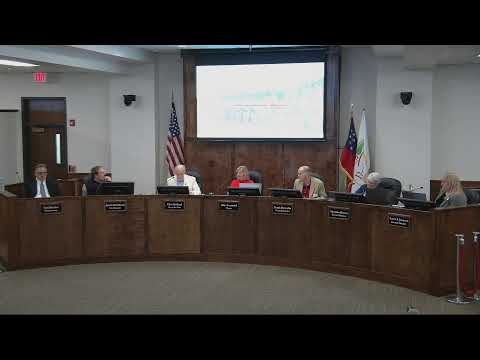
Peachtree City staff asked the council Thursday to authorize a scientific study to estimate the city’s deer population and identify hotspots before the city considers active management measures on city property. The council signaled support to proceed with the study.
Chris Hobby, presenting the department report, said vehicle collisions, landscape damage and potential disease vectors are the principal concerns prompting the review. The council was told Fayette County ranks second in the state for raw vehicle-vs.-deer collisions, and staff cited Fairfax County, Va., and Forsyth County, Ga., as models where regulated, primarily archery-based programs reduced collisions and landscape damage without safety incidents reported in Fairfax.
Hobby said the proposed first step is a data-driven herd assessment that uses nighttime aerial surveys (drones) and ground observation to map where deer congregate and reproduce. Staff supplied a cost estimate of about $25,000 for the initial study and said that the study could be completed quickly. He emphasized that the study would inform any further steps — for example, targeted regulated archery hunts on select public parcels, or, in locations where archery is infeasible, USDA sharpshooter operations conducted by professionals.
Council discussion focused on safety protocols, public education, and the legal framework. Hobby noted state law reserves hunting regulation to the Georgia Department of Natural Resources and that the city’s authority is limited to public-safety rules (for example, regulating discharge in municipal parks). He also noted doe movement tends to be limited geographically, which makes targeted, localized management effective.
Councilmembers expressed support for starting with the herd study. No ordinance or management program was adopted at the workshop; staff will return with a recommended scope of work, vendor options and a contract for the herd study.