Get Full Government Meeting Transcripts, Videos, & Alerts Forever!
Get email alerts on the Broadband topic
No spam. Unsubscribe anytime.
State and private partners say broadband build is underway in Patrick County, but federal permits slow some sections
Summary
State and private broadband partners told the Patrick County Board of Supervisors on April 14 that most funded projects are under construction or near completion, but crossings of the Blue Ridge Parkway and permitting delays remain the main obstacles to finishing service to several clusters of homes.
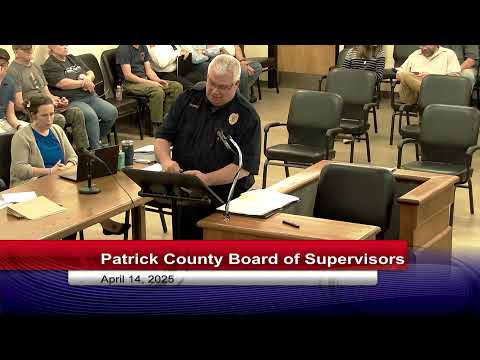
State broadband and private providers told the Patrick County Board of Supervisors on April 14 that publicly funded projects slated to bring fiber and cellular coverage to much of the county are progressing, but federal and highway permitting are slowing final connections in some areas.
The presentation by Dr. Holmes, director at the Virginia Department of Housing and Community Development (DHCD), Appalachian Power representatives, River Street Networks and Charter Communications summarized four separate grant-funded efforts now active in Patrick County. Dr. Holmes said a 2022 Charter project is about 98% complete and that River Street’s regional projects—backed by Appalachian Power middle-mile fiber—are under construction with a combined completion target in 2026.
The update matters because the projects together aim to bring fiber to more than 90% of county addresses when combined, while a separate new federal-state program will fund cellular tower upgrades for areas that lack reliable 4G coverage. “There are about 8,000-plus locations in the county that lack cellular coverage and roughly 600 miles of road without adequate cell service,” Dr. Holmes said, noting a forthcoming cellular connectivity grant program.
Appalachian Power told the board it has completed substantial make-ready work but still must replace or reconfigure hundreds of utility poles in Patrick County before final fiber can be hung. Rob Mann of Appalachian Power said the company has identified about 386 poles requiring replacement and 338 needing reconfiguration in county segments of the project. He and other presenters said VDOT permitting and federal reviews for Blue Ridge Parkway crossings are the largest schedule risks.
River Street Networks described its phased plan to deploy distribution fiber, saying the company expects to serve roughly 8,800 locations in the county under current contracts and has filed additional applications to expand coverage. River Street said it is using Appalachian Power’s transport routes where possible; that approach reduces cost but requires complex engineering where the available utility fiber is smaller than the carriers typically use, increasing the number of remote nodes.
Charter reported that its VADI- and RDOF-funded builds are complete in all areas that did not require a Blue Ridge Parkway crossing, and that service is active where crews have finished construction. Company representatives said the outstanding addresses are tied to a small number of segments that need the Parkway permit.
All presenters pointed supervisors and residents to publicly accessible project dashboards—DHCD’s VATI/VADI dashboard and River Street’s project map—so citizens can check build progress and see which properties are queued for service.
Supervisors asked about permit timelines and cost responsibilities for pole replacement. Appalachian Power said most pole replacement costs in the current projects will be borne by the utility. Presenters and staff said they are coordinating with VDOT and federal agencies to accelerate reviews where possible but acknowledged some permit processes can take many months.
The presentations concluded without formal board action; supervisors approved an environmental review record later in the meeting related to an Appalachian Regional Commission (ARC) broadband grant, clearing a federal environmental step needed before contract execution for that grant.