Get Full Government Meeting Transcripts, Videos, & Alerts Forever!
Get email alerts on the Fairgrounds Development topic
No spam. Unsubscribe anytime.
Supervisors decline expansion to 'Grandpa shed' at fairgrounds but approve sheep-and-goat wash station
Summary
After receiving a recommendation from the fair board, the supervisors voted not to permit an addition to the historical building known as 'Grandpa shed' citing space, utilities and circulation constraints; the board approved a separate, donor-funded wash bay for sheep and goats between the swine and small-animal barns.
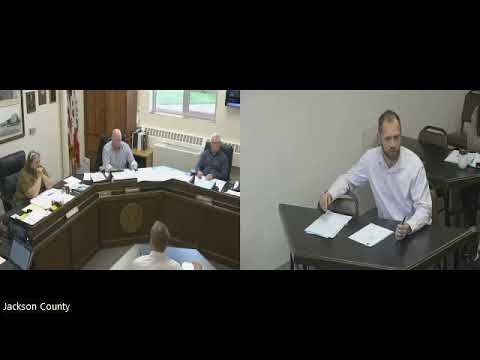
Jackson County supervisors on April 15 rejected a proposal to add a lean-to to the historical building referred to in meeting discussion as "Grandpa shed," and separately approved a donor-funded wash station for sheep, goats and hogs at the county fairgrounds.
The fair board manager, Terry Selzer, briefed the supervisors on both proposals and said the fair board recommended against expansion to the north, east or south of the building because of buried utilities, memorial trees, limited turning radius for large livestock haulers and frequent use of the adjacent space for camping and events.
"It seems like every Saturday night trying to keep traffic off of Platt Street, people are parked 2, 3 wide on the road," Selzer said, arguing that expansions to the south would reduce campground and access area used for larger events. He also said a water line, power and gas infrastructure run on the east side and that a north addition would require removing memorial trees and would only yield limited usable interior space.
Supervisor then moved and Supervisor Mike Steinas seconded a motion “to not allow expansion on Grampa’s shed due to feasibility.” The motion carried.
Selzer said the fair board is supportive of other improvements and presented a separate plan from the fair’s sheep-and-goat committee to install a roughly 20-by-30-foot wash bay between the swine barn and the sheep/goat barn. He said the committee has funding and volunteer labor already pledged, and that the work would be primarily concrete slab construction with removable internal panels so pens can be taken out during winter.
"They came to the board with the plan, the board has approved this, and I want to bring that to you guys," Selzer said, describing the proposed wash station and how it would be served from an existing hydrant by a hose for seasonal use.
Supervisor Mike moved to approve the installation of the sheep-and-goat wash station as presented; Supervisor Nin seconded. The board voted and approved the project. Selzer said the fair board will provide blueprints and funding documentation to county staff.
Nut graf: The supervisors’ decisions balance preservation and practical use of fairgrounds property: they declined the historical society’s requested expansion because of access and utility constraints but approved a smaller, donor-funded facility intended to reduce scheduling conflicts for animal exhibitors.
Background and context: County staff and board members cited several limiting factors — memorial trees and a water line to the north, gas and electric services at the east facade, and insufficient turn radius and campsite loss at the south — when explaining why an addition would be impractical. Selzer also noted that Boyer Hall (another fairgrounds building) needs roof work and that relocating uses among buildings has trade-offs for revenue and functionality.
Ending: The supervisors asked fairgrounds staff to provide any further cost estimates for utility relocation if the historical society wishes to pursue a different plan; for now the fair board's recommendation stands and the sheep-and-goat wash bay will proceed under the committee’s funding and volunteer plan.