Get Full Government Meeting Transcripts, Videos, & Alerts Forever!
Get email alerts on the Redevelopment Mlk 15 topic
No spam. Unsubscribe anytime.
Panama City CRA directs staff to negotiate with Sankofa Group for MLK–15th Street redevelopment
Summary
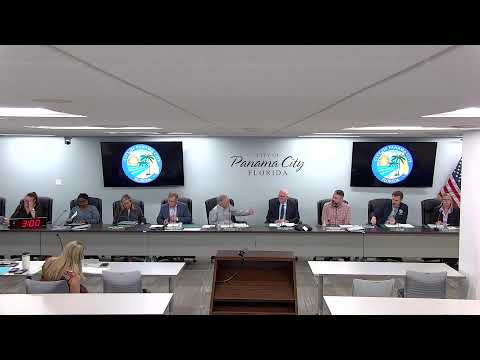
The Panama City Community Redevelopment Agency on April 15 directed staff to negotiate next steps with the Sankofa Group LLC for redevelopment of the southwest corner of East 15th Street and Martin Luther King Boulevard after a developer presentation and public questions.
The Panama City Community Redevelopment Agency on April 15 directed staff to negotiate next steps with the Sankofa Group LLC for redevelopment of the southwest corner of East 15th Street and Martin Luther King Boulevard, after a presentation from the developer and an extended public Q&A.
The board’s direction follows a presentation by Pedro Gassant, principal of the Sankofa Group, who described a phased mixed‑use plan centered on a roughly 16,000‑square‑foot grocer supported by about 60 apartments and about 22 townhomes. “We think that really having the grocer is going to be what helps to drive this site,” Gassant told the board. He said the group budgets the project between about $30 million and $60 million and estimated a development timeline of about 24–36 months from start to finish, after entitlements and site investigations.
The issue matters to Glenwood residents because the corner sits in an area community members long described as a food desert. The board and public repeatedly framed the project around securing a grocer while preserving affordability and minimizing displacement. Board member Lucas urged caution on gentrification and said the board must be deliberate about who it partners with to bring retail, housing and related investments to Glenwood.
During his presentation, Gassant showed conceptual renderings and said the design would prioritize a plaza and pedestrian access rather than a sea of surface parking. He described the parcel’s irregular “Christmas tree” shape as the main technical challenge for siting a visible grocery entrance and parking; he said acquiring adjacent parcels would improve visibility and feasibility. He told the board his team has equity partners and banking relationships to fund the work but needs geotechnical, percolation and Phase I environmental reports to finalize pro forma costs. “We would have to prepare the construction documents…permit the site work…and then it would take anywhere between 24, 36 months to be able to get this done from soup to nuts,” Gassant said.
Community speakers urged the board to prioritize homeownership and long‑term residents’ return. Michelle Bryant, a Glenwood resident, said the site was purchased in 2017 with community expectations of modest homeownership opportunities and retail. Tony Champlain, who owns property in the Downtown North CRA, urged the board to ensure CRA plans remain current and mindful of statutory timelines. Several residents asked whether the developer would pursue national chains (Gassant cited Trader Joe’s or Sprouts as examples of the kind of boutique grocer he would pursue) and how affordability would be achieved.
Board members pressed specifics. Questions and answers included: the developer’s financing sources (equity partners and bank relationships), an estimated total project budget ($30M–$60M), and the need for site work and entitlements. Gassant said some remediation of configuration and parcel assembly would likely be required and confirmed a Brownsville grant is already funding a Phase I for one corner.
After the presentation and public Q&A, the board moved to authorize staff to work with the Sankofa Group on a formal next step—drafting a letter of intent or memorandum of understanding that could lead to either an outright purchase with protections (for example reverter terms) or a public‑private partnership with performance metrics and an explicit grocer commitment. Board member Lucas made the motion, which Halligas seconded; the roll call recorded affirmative votes from Halligas, Lucas, Granger, Street and Chairman Rowan. The motion is nonbinding and directs staff to return a formal proposal and timeline for further board consideration.
Discussion points that the board and community asked staff and the developer to address in the next phase include assembling adjoining parcels, concrete affordability targets (unit counts and AMI levels), firm grocery commitments and timeline milestones, potential incentives (TIF or other CRA tools), and community engagement workshops so residents can give early input.
The board did not approve a final development agreement or any sale at the meeting; the action was limited to authorizing staff negotiations and preparation of a formal proposal for a future meeting.