Get Full Government Meeting Transcripts, Videos, & Alerts Forever!
Get email alerts on the European Security topic
No spam. Unsubscribe anytime.
Panelists: Ukraine war, transatlantic ties and security architecture dominate Europe’s security debate
Summary
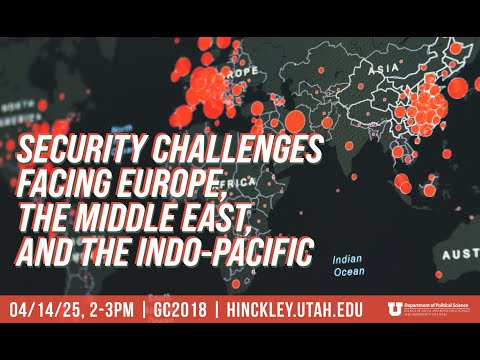
At a Hinckley Forum at the University of Utah, panelists said the war in Ukraine, uncertain U.S. engagement and competing ideas about Europe’s security architecture are the three dominant challenges facing European security, and they urged higher defense spending and deeper regional cooperation.
At a Hinckley Forum at the University of Utah, panelists said the war in Ukraine, strained transatlantic relations and disagreement over Europe’s security institutions are the primary security challenges confronting European states.
Stephen Lobel, professor of political science at the University of Utah and the panel moderator, introduced the discussion and asked panelists to outline the chief security concerns facing Europe. Anders Veil, professor of international relations at the Department of Political Science at the University of Copenhagen, identified three linked challenges: the war in Ukraine, fraying transatlantic ties and debate over which forums should organize European security.
Veil said the Ukraine war presents military, economic and political problems for European states and has already produced disruptions beyond the battlefield. “The Ukraine war was a security challenge for European states,” Veil said, and he pointed to possible spillovers such as instability in Moldova or pressure on Baltic states. He noted many European countries had low defense spending “between 1.5 and 2% of GDP until fairly recently” and argued budgets likely need to rise to the roughly 3–4% range over a short period to meet current threats.
Veil described a second challenge as transatlantic relations: most European states remain NATO members and Atlanticist in orientation, he said, but the exact shape and level of future U.S. engagement is uncertain. “There’s a lot of insecurity on what will be the extent of U.S. engagement in Europe,” he said. The third challenge, he said, is the European security architecture — which institutions will lead, whether France, a stronger European pillar within NATO or other coalitions will set policy, and whether European states can agree on the content of any peace settlement for Ukraine.
Panelists discussed likely institutional responses. Veil said he does not expect the European Union to replace NATO or to develop an EU command of armed forces; rather, he predicted a stronger European pillar inside NATO, paired with regional coalitions of “able and willing” states likely organized around geopolitical interests and strategic culture. He cited a rising security conversation among Nordic and Baltic states, Poland and the United Kingdom as one example of such a cluster.
On preparedness, the panel noted multiple constraints beyond headline spending figures: technological dependence, command-and-control practices shaped by decades of cooperation with the United States, and limits in domestic defense industries. Veil said many European countries agreed after 2014 to aim for defense spending at or above 2% of GDP but that most failed to meet that target.
The forum included audience Q&A that raised alliance credibility, Russia’s actions in peripheral theaters (including undersea infrastructure disruptions noted by Veil), and the limits of a purely European response without continued U.S. partnership. Lobel closed the session after a broadly held view that Europe must increase defense capacity while seeking predictable coordination with the United States.
Less critical details: Panelists framed these debates as ongoing and contingent; no formal recommendations or votes were taken at the event.