Newton County Schools presents $265 million FY26 budget amid questions on telehealth billing and contracted services
Loading...
Summary
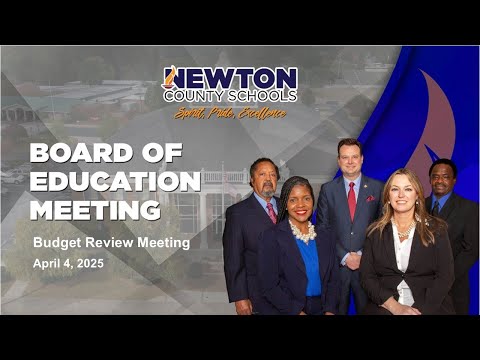
Newton County Schools presented a proposed $265,000,000 general fund budget for fiscal year 2026 at a special budget workshop, with district leaders saying the plan reflects "a spirit of fiscal moderation" while also relying on about $17 million of fund balance to offset a revenue-expenditure gap.
Newton County Schools presented a proposed $265,000,000 general fund budget for fiscal year 2026 at a special budget workshop, with district leaders saying the plan reflects "a spirit of fiscal moderation" while also relying on about $17 million of fund balance to offset a revenue-expenditure gap.
The budget team said district leaders forecast a net $4,600,000 decrease in state funding, offset in part by projected local increases; officials described the overall proposed expenditures as $16,900,000 higher than FY25, driven mainly by implementation of a classification and compensation study and rising employer benefit costs. Chief Financial Officer Erica Robinson said the district is projecting enrollment of 18,747 and an estimated per-pupil expenditure of $14,138 for FY26.
The proposal allocates the majority of salaries and benefits to direct instruction: 65.93% of total salaries and benefits are earmarked for classroom instruction, with school administration (7.87%), pupil services (5.8%) and student transportation (5.16%) together accounting for 84.76% of that budget line.
Why it matters: District officials said the budget balances competing pressures—falling state QBE allocations, higher employer health and retirement contributions, and one-time federal ESSER grant reductions—while attempting to preserve student-facing services. Board members asked for additional detail on contract structures and the projected drawdown of reserves before the board takes action on the final budget.
Revenue and expenditure highlights CFO Erica Robinson summarized preliminary revenue shifts tied to the state QBE formula and local property valuations. Robinson said the district projects: - A net projected decrease in state funding of approximately $4,600,000, driven by items including equalization funding (estimated decline about $3,600,000) and timing/changes in QBE components. Robinson cautioned that official QBE allocations from the Georgia Department of Education have not yet been released and figures are preliminary. - Projected increases on the local side of about $2,900,000, including roughly $2,100,000 from an estimated 6% rise in the local property digest and $1,300,000 expected from joint development authority distributions (the presentation referenced a planned $5,500,000 distribution among participating counties). - Overall proposed FY26 expenditures of $265,000,000, an increase of $16,900,000 over FY25 in the presentation.
Division-level changes and notable programmatic items - Operations: Chief Operations Officer Dr. Michael Barr said operations budgets generally decreased, with increases only in safety and security resulting from reclassifying the school resource officer (SRO) contract into a newly created school safety function code (Dr. Barr confirmed the reclassification is "a wash"). The division proposed adding three maintenance positions (budget-neutral through reduced contracted services) and two additional bus monitor positions to ensure compliance with student IEPs.
- Strategy and Support Services: Chief Sheila Thomas said the division is rolling Communities in Schools wraparound supports for West Newton, Clements and Newton High from ESSER into the general budget; funding will support one Communities in Schools staff person per school. Thomas described a separate Hispanic Family Engagement initiative with a small general-fund appropriation and explained that the transition from ESSER reduced coverage from five schools to three but remains a district priority.
- Mental/telehealth services (Hazel Health): Board members pressed staff about the Hazel Health contract and whether the district or Hazel Health bills student insurance. A board member said she had reviewed the vendor link and saw fields for insurance and asked whether the district was double-paying if Hazel billed insurers. Thomas and other staff clarified that the insurance fields on the public intake relate to physical-health pilot services and not the mental-health portion paid for by the district; Thomas said the district would ask Hazel Health to remove or separate the insurance fields for mental-health access to avoid confusion and potential deterrence for students seeking services. District staff also said Hazel Health offered a discount for the upcoming year that covers all 24 schools under a contracted amount (the presentation cited an $180,000 figure for the service contract).
- Learning & Leadership: Chief Tracy Blackburn outlined net reductions across several departments tied to the instructional resources audit, including a $350,000 reduction in textbook spending and reallocations to assessment and data systems. The division proposed two special-education positions for compliance and teacher support and several strategic investments in assessment platforms, professional development, and CTAE equipment.
- Human Resources: Chief Niree Sanders said the HR budget shows a modest decrease achieved by postponing initiatives; the only personnel change is a budget-neutral reclassification to create an employment specialist role. HR proposed continued investment in recruitment and absence/substitute management software.
- Public Relations: Sherry Partee said PR would reduce travel and shift graduation sign costs to school budgets, consolidating some events into a single spring awards program; the PR budget includes continued spending for ADA compliance remediation of district web content, citing Section 508 of the Rehabilitation Act.
- Business Services: Robinson said the division anticipates higher general liability insurance premiums and no new positions; school allocations reflect projected enrollment and student classification changes.
Board questions and next steps Board members requested more detail on several items before final approval: an analysis comparing contracted bus maintenance vs. in-house staffing (one board member urged converting contract work and adding at least two in-house mechanics and asked staff to provide an update before the April 22 board meeting), clarification of how much of the budget drawdown will reduce the ending fund balance and how that percentage compares to GSBA recommendations, and further details on the Hazel Health contract’s billing and scope. Superintendent Dr. Bradley said the board will take action on compensation-classification items at the April 22 meeting and staff will continue monitoring state QBE allocations and local revenue developments.
Actions recorded at the workshop The board unanimously voted to enter and later exit an executive session to discuss personnel matters; after returning to open session the board moved to approve the matters discussed in executive session (mover: Miss Henderson Baker; second: Mister Eddie Johnson), and then moved to adjourn (mover: Miss Henderson Baker; second: Mister Eddie Johnson). The budget workshop concluded with the board requesting follow-up information on transportation contracting, fund-balance percentages, and contract billing clarifications.
Ending District leaders framed the FY26 proposal as deliberate restraint: "we have very clearly produced a budget that ensures that we are financially lean and operationally efficient," Superintendent Dr. Bradley said, while also noting the board will review compensation-study findings and other adjustments at upcoming meetings.