Get Full Government Meeting Transcripts, Videos, & Alerts Forever!
Get email alerts on the Annexations topic
No spam. Unsubscribe anytime.
Leesburg commission rejects resolution to signal pause on residential annexations
Summary
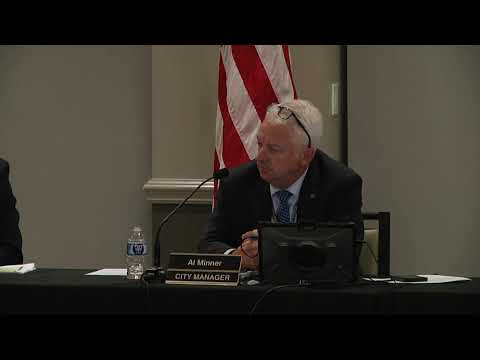
After hours of testimony and a presentation from City Manager Al Minor, the Leesburg City Commission declined to adopt a nonbinding statement signaling a temporary pause on residential annexations and rezonings. Residents, business groups and developers split sharply in public comment over roads, water and planning.
City Manager Al Minor told the Leesburg City Commission he recommended against signaling a temporary suspension on residential annexations and rezonings, and the commission voted not to adopt the proposed resolution after extensive public comment and debate.
Minor opened the discussion with data and a recommendation: "my office is recommending the commission to vote against the suspension of residential annexations and rezonings," he said, describing why he said a blanket pause would not address the countywide issues that affect growth, such as roads, schools and water. Minor walked commissioners through approved planned unit developments (PUDs), explained that a PUD "is not a development order" and outlined recent utility work, including a $40,000,000 Turnpike wastewater plant expansion and the city’s efforts to seek a larger consumptive-use permit for water from the St. Johns River Water Management District.
The presentation drew lengthy public comment both for and against any pause. Business groups including Lake 100, the Leesburg Area Chamber of Commerce and the Lake & Sumter Homebuilders Association urged the commission not to adopt a blanket halt, warning it would create uncertainty that would slow investment and jobs. "A moratorium or a suspension is just stopping future planning. It's the same logic as sticking your head in the sand," said Adam Edgington of the Lake & Sumter Homebuilders Association.
Local business owners and developers said a pause would threaten construction jobs and ongoing projects. Andy Price, who recently opened a business in Leesburg, told the commission: "I have full faith in our city leadership to manage the growth wisely," and urged continued annexation and development that he said creates local jobs.
Opponents of continued expansion, including many residents from South Leesburg and neighborhoods along County Road 48, urged a temporary pause so the city and county can address traffic, school capacity and water supply. Several speakers pointed to congested intersections (notably the Dixie intersection and County Road 48/33) and urged the commission to prioritize infrastructure. "We are imploring the city commission to not approve any more developments or allow for rezoning the land presently zoned for agriculture until such time as more critical issues are addressed," said Terry Gebben, president of Legacy of Leesburg homeowners board.
City staff and members of the public debated technical points the traffic studies use: Minor and staff said traffic impact studies evaluate whether a new development would degrade a roadway’s level of service and that each study typically includes previously approved developments along the corridor. County staff submitted comments requesting additional right of way and turn-lane improvements along County Road 48; developers and applicants agreed to coordinate and grant frontage right-of-way and to provide required turn lanes.
Minor emphasized water and sewer constraints, saying that after the Turnpike plant expansion and other work the city estimates a planning-level capacity of roughly 7,200 additional sewer-connected units to the Turnpike plant and about 8,000 additional units relative to the city’s current consumptive-use permit and average use figures; he added that the St. Johns District declined an immediate increase to the city’s consumptive-use permit (to 15 MGD) and told the city to return when capacity is reached or when the permit expires in 2030. Minor said those factors argue for careful, phased planning rather than a simple blanket policy change.
After discussion the commission took a roll-call vote. The motion to adopt the resolution was moved and seconded; the roll-call recorded these votes as read on the dais: Yes — Commissioner Jay Connell; No — Commissioner Burry, Commissioner Peterson, Mayor Alan Reisman. (A commissioner’s recorded vote was not specified in the public transcript.) The motion failed and the proposed statement did not become official city policy.
The commission left open the standing planning and permitting processes: staff reiterated that existing approvals and permits remain in force and that commercial annexations and individual development applications continue to be considered under current rules. Commissioners said they expect continued coordination with Lake County on road projects and with the St. Johns district on water-supply timing, and several members suggested revisiting policy and impact-fee structures to better align infrastructure funding with growth.
Votes at a glance
- Proposed resolution expressing the commission’s current position regarding residential annexations and rezonings — motion to adopt (moved and seconded): FAILED. Roll-call (as recorded in meeting transcript): Yes — Commissioner Jay Connell; No — Commissioner Burry; No — Commissioner Peterson; No — Mayor Alan Reisman. (One commissioner’s vote not recorded in the transcript.)
Ending
The question of how to balance rapid residential growth with roads, schools and utility capacity remained unresolved at the meeting’s end. Commissioners signaled further work with county and state partners and continued use of the city’s standard review process for individual annexations and rezonings. Several members said the commission will continue reviewing impact fees, concurrency requirements and intergovernmental coordination in coming months.