Get Full Government Meeting Transcripts, Videos, & Alerts Forever!
Get email alerts on the Transportation Infrastructure topic
No spam. Unsubscribe anytime.
UDOT identifies Alternative C as preferred option in Kimball Junction draft EIS; public comment period open
Summary
The Utah Department of Transportation presented the draft environmental impact statement for the Kimball Junction study and named Alternative C — intersection improvements with pedestrian enhancements — as the preferred alternative; the public comment period runs through April 28, 2025.
The Utah Department of Transportation presented the draft environmental impact statement for the Kimball Junction study at a virtual public hearing and identified Alternative C, the “intersection improvements with pedestrian enhancements” option, as the preferred alternative. UDOT announced the 45-day public comment period runs from March 14 through April 28, 2025, and said it intends to issue a final EIS and record of decision later this year.
UDOT Project Manager Becky Stromness said the draft EIS compared three alternatives developed from the 2021 Kimball Junction Area Plan and screened them against purpose-and-need metrics, environmental and regulatory constraints and cost. “Alternative C, known as intersection improvements with pedestrian enhancements, has been identified as the preferred alternative,” Stromness said during the hearing.
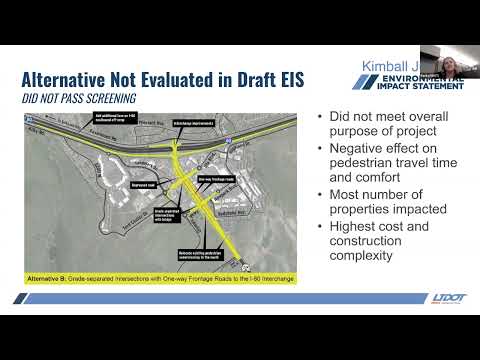
The agency said Alternative B (grade‑separated intersections with one‑way frontage roads) was eliminated early in the screening because it did not meet the project’s pedestrian and bicyclist mobility and comfort goals, would require the most property impacts and carried the highest cost without substantially greater benefits. Alternatives A (split‑diamond interchange with intersection improvements) and C were evaluated further; both met purpose‑and‑need criteria for travel time, queue lengths on the I‑80 off‑ramps, and active‑transportation improvements.
UDOT presented comparative metrics from the level‑3 screening. Alternative C performed best for intersection level of service and reduced the I‑80 off‑ramp vehicle queue by roughly 200 feet compared with Alternative A. Alternative A had a modest advantage for some transit travel times—about 30 seconds better in some measures—and showed a one‑minute advantage in certain walk‑time origin‑destination pairs. Many environmental resource impacts were similar between A and C, but Alternative A would convert more land to roadway (about 4.86 acres versus 3.5 acres for Alternative C) and would affect utility infrastructure (including a local pump house) and slightly greater aquatic and floodplain impacts, Stromness said.
Cost differences were a major factor. UDOT noted a nearly 60% cost gap between Alternatives A and C; the agency estimated Alternative C would cost more than $75 million less than Alternative A. The draft EIS also assessed noise and recommended two noise walls for balloting to affected property owners: Noise Wall 1, roughly 17 feet tall and 1,300 feet long, and Noise Wall 2, about 14 feet tall and 600 feet long.
Key features of the preferred Alternative C include additional lanes on the I‑80 eastbound on and off ramps; a third travel lane in both northbound and southbound directions on State Route 224; dual left‑turn lanes at the Ute Boulevard and Olympic Parkway intersections; separated right‑turn lanes; a new pedestrian underpass between Ute Boulevard and Olympic Parkway; and buffered bike lanes along State Route 224. Stromness said the preferred alternative “provides acceptable level of service at all intersections” and “is a more reasonable expenditure of funds for the anticipated operational benefits” than Alternative A.
Members of the public who spoke at the hearing expressed both support and reservations about the preferred alternative and the broader approach. Resident Bob Jackaud said he appreciated the project team’s work but questioned whether the study’s scope addresses the wider traffic problems residents see across SR‑224. “I do almost sadly lean towards doing nothing,” Jackaud said, adding that if the project does not address the broader SR‑224 congestion, he worries two years of construction will not fully solve the area’s traffic challenges.
Resident Ernest Orenti, who said he has lived in the area for 27 years, told UDOT he supports a path forward and urged the agency to keep studying additional options if needed. “I really am excited to hear that this is moving forward. It needs to happen,” Orenti said.
A phone participant, Mari Menel‑Bell, raised concerns about wildlife and the need for a comprehensive plan for the area. “I have personally witnessed several terrified moose getting trapped alongside the westbound exit ramp of I‑80 at Jeremy Ranch,” she said, and urged UDOT to include wildlife protections and coordination with local planners.
UDOT staff reminded attendees that comments submitted during the hearing and through the study website, phone, mail or email will be recorded and that UDOT will respond to comments in the final EIS. Stromness said the agency considered transportation performance, environmental and human‑resource impacts and cost in identifying the preferred alternative and reiterated that selecting Alternative C “doesn’t preclude any elements of Alternative A potentially happening in the future.”
The draft EIS and display materials are available on the project study website; UDOT is accepting comments through April 28, 2025. The agency said it will review and respond to all submitted comments as part of the final EIS and record of decision process later this year.