Get Full Government Meeting Transcripts, Videos, & Alerts Forever!
Get email alerts on the Docks And Canopies topic
No spam. Unsubscribe anytime.
Board weighs dock limits, navigation rules and boat‑canopy language
Summary
Port Richey board members reviewed competing state, federal and local rules that affect docks and vessel access, discussed the unclear boundaries of the Nature Coast Aquatic Preserve in Pasco County, and expressed broad support for code language to allow engineered boat canopies while limiting debris and navigation impacts.
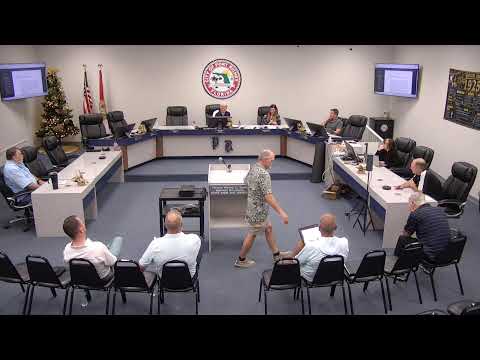
Board members at the April 14 Port Richey City Court Authority Board workshop moved from seawalls to docks and boat canopies, framing the discussion around navigation rights, federal and state percentage limits on dock footprint, and a question the board could not immediately answer: which waterways fall inside the Nature Coast Aquatic Preserve’s regulatory boundary.
City Attorney Nancy Meyer summarized the complexity: federal rules prioritize navigation and reserve a share of the waterway for navigation, state rules use different percentages for aquatic preserves, and local riparian rights further complicate permissible dock area. Meyer told the board she found the Nature Coast Aquatic Preserve mapping and language “mixed” in Pasco County and said the issue required more study before the city adopted a uniform footprint rule.
The board discussed the common local starting point — a one‑third/one‑third/one‑third split of channel width — but several members said that approach did not fit narrow canals. Meyer said she personally favored something “less than 1 third, 1 third, 1 third” in some locations to protect navigation and to avoid docks or vessels that effectively block a channel.
Several members and residents urged stricter enforcement of permit requirements for docks. Resident Dave Mueller said bootleg docks and floating structures have been installed without permits and can “impede ingress and egress.” He appealed for city enforcement to preserve navigable access and canal depth.
The board then addressed boat canopies and lift covers. One participant said the city already has canopies and removable covers and argued the city should adopt standards that allow engineered, removable canopies while reducing hurricane‑debris risk and ensuring that frames meet wind‑load engineering requirements. John R. Cooper suggested the city allow engineered permanent roofs where appropriate: “I would advocate that, we'd have actually roofs available as well if they're engineered appropriately,” Cooper said.
Members discussed overhang limits tied to local canal width and adjacent navigation; staff suggested that pilings should be set to accommodate future covers, and that any canopy design must address how to prevent cover debris from becoming hazards during storms. Participants agreed that specific canal measurements and a map of canal widths/centerlines would be necessary to apply consistent limits across the city.
Meyer said she will research the aquatic preserve boundary, federal/deputy district rules, and sample codes, and will return with draft language. The board directed staff to collect canal dimensions and examples of problematic unpermitted docks and to prepare model ordinance language for further review.
Ending: The board asked staff for technical canal data and for draft code language that would clarify allowable dock footprint, separation from federal channels, and rules for canopy design and removal or breakaway features during storms.