Get Full Government Meeting Transcripts, Videos, & Alerts Forever!
Get email alerts on the Seawalls And Bulkheads topic
No spam. Unsubscribe anytime.
Port Richey board starts workshop to draft seawall and bulkhead rules
Summary
At an April 14 workshop, the Port Richey City Court Authority Board heard staff and public input on drafting a city ordinance to regulate seawalls, bulkheads and related shoreline repairs, focusing on safety, inspection standards and what repairs require permits.
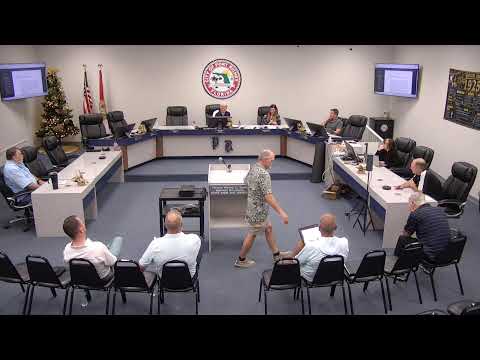
The Port Richey City Court Authority Board on April 14 opened a workshop to begin drafting city rules for seawalls and bulkheads, saying current local code does not adequately address deteriorating marine retaining structures.
City Attorney Nancy Meyer framed the session as a restart of a years-long effort. “We are starting over, essentially,” Meyer said, describing packets of model language and technical references from Marco Island, Holmes Beach, Belleair Beach and federal guidance the board could use as a baseline.
The discussion focused on public-safety triggers, inspection intervals and what repairs must be permitted. Meyer and members repeatedly emphasized that the city’s present code gives limited ability to require maintenance or to cite a seawall short of a nuisance lawsuit. The building department and board members pressed for objective, observable standards so that owners, neighbors and staff can know when a structure needs professional repair.
Public commenters and board members urged a practical approach. Terry Reelitz of the Salt Strong Organization Fishing Club said the site’s public-safety problems motivated the group’s interest: “My passion is to help kids learn how to fish,” Reelitz said, and he described jagged rocks and damaged launch areas at Brasher Park.
Resident Dave Mueller urged criteria that a layperson could use to spot a failure from the road or by boat. “What we’re trying to do is… put something in place that somebody can stand at the road or at the water side and look and say, ‘Yeah. We got a problem there,’ ” Mueller said.
Ideas surfaced repeatedly rather than firm code language: several speakers recommended adopting or citing established standards (for example, Florida Department of Transportation or Army Corps guidance) “as adopted and subsequently amended” so the city does not rely on an out‑of‑date edition; others recommended a simple visible‑failure list (voids, displaced panels, significant washout) and an inspection cadence such as a five‑year general assessment cycle. Technical thresholds discussed included a footer depth of roughly 12 inches below grade as a common construction practice and a recommended use of engineered solutions for new or replacement walls; the Army Corps’ “good/fair/poor” observational categories were cited as a possible assessment framework.
Board members and staff discussed allowing alternative materials (concrete, steel, timber, riprap) when designs are engineered, while ensuring repairs or replacements meet an engineered standard when a visible failure is identified. The group considered permitting maintenance that is nonstructural (epoxy cracks, spot repairs) without a permit, while requiring engineered plans and permits for structural repairs or full replacements that alter a footer or extend seaward.
Speakers debated enforcement logistics: the building official can inspect only areas the public can access and cannot walk uninvited onto private property; waterborne inspections and neighbor complaints are frequently how visible problems are first discovered. Several participants linked seawall deterioration to other local issues, including stormwater drainage and excessive boat wakes. Board members agreed staff should draft specific language that identifies observable failure indicators and clarifies when a permit and engineered plans are required.
City Attorney Nancy Meyer said she will circulate follow‑up materials and a list of recommended observable failure items and referenced codes to guide a draft ordinance. The board scheduled further work sessions to refine code language for seawalls and related marine structures.
Ending: Board members asked staff to draft proposed ordinance language that would be routed to the board, then P&Z and ultimately the City Council for consideration. Meyer said she will email follow‑up documents and model code examples to the board to begin formal drafting.