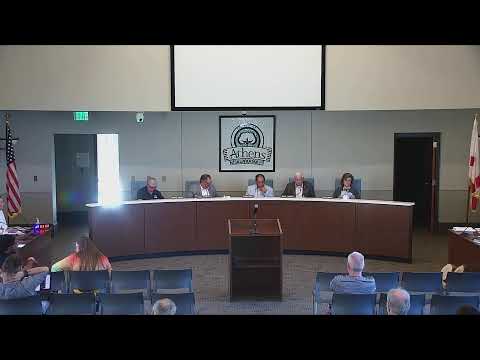
Athens Council approves Toyota MOU; utility seeks retail rate restructuring billed as revenue neutral
Loading...
Summary
The City of Athens on April 14 approved a memorandum of understanding with Toyota of America to support a feasibility study for a Limestone County solar installation and adopted a retail-rate restructuring for Athens Utilities that raises the monthly customer charge while lowering the energy charge, officials said.
The City of Athens on April 14 approved a memorandum of understanding with Toyota of America to support a feasibility study for a proposed solar installation in Limestone County and advanced a separate retail-rate adjustment for Athens Utilities that shifts more fixed cost recovery into a higher monthly customer charge while lowering the energy charge.
Hunter Allen, electric service manager for Athens Utilities, told the council the Toyota memorandum would allow Toyota to proceed with a study of a proposed solar project that includes 13 other electric utilities in the region. "What that allows us to do is ... we're exploring a project with 13 other electric utilities for a solar installation in Limestone County," Allen said. He added the agreement requires no direct financial contribution from Athens Utilities: "So there's no, you know, financial involvement that we are required to put up for this project. It's just allowing us to agree to the terms of the agreement."
The council also approved a retail-rate adjustment for the electric department that, according to Allen, increases the monthly customer charge from $16.66 to $18.66 while reducing the per-kilowatt-hour energy charge so the change is revenue neutral overall. Allen said the adjustment reduces variability in utility revenue caused by weather-driven changes in consumption: "It just takes less variability out of our budget based on weather because that's where a lot of our budget comes from is power veil through weather. And so the less variability we have, the better we can budget." He told council staff expect the change to produce roughly a 1.5% decrease in the energy charge and that, for an average residential customer, the final monthly bill would be unchanged under the example shown on a slide.
Councilmember Wells pressed Allen on customer impact and on the risk Athens Utilities could later raise rates without council approval. Wells said he was reluctant to place an added charge on residents when the city has a surplus. "It just seemed to me ... it sets the stage for an increase by Athens Utilities later on," Wells said. Allen replied that any future rate changes would have to come back to council first: "We would have to come back to council for any type of rate adjustment, increase, decrease, whatever. It has to come to you guys first and foremost before it goes to TVA for approval. So we can't just willy nilly increase rates without y'all's approval. Y'all are our governing board."
Wells also asked whether the Toyota solar project could reduce Athens Utilities' revenue if Toyota used the solar power at its plant. Allen said the planned solar installation would be a direct connection to the Tennessee Valley Authority (TVA), not to Toyota's plant, and therefore would not reduce the plant's purchases through Athens Utilities. "This solar project ... won't connect to Mazda Toyota's facilities. It'll direct connect directly to TVA, so there won't be any lost revenue on the Mazda Toyota side," Allen said. He explained TVA would purchase generation from the solar facility and Athens Utilities would transact with TVA under that arrangement.
Both items moved forward with council approval. The memorandum of understanding with Toyota passed on a recorded vote of 5-0. The retail-rate adjustment was adopted as part of the consent calendar and approved by the council; city staff said the adjustment will take effect for bills with meter readings on or after Oct. 1, 2025, contingent on TVA approval.
What happens next: Toyota will proceed with the feasibility study if the MOU is executed; the retail-rate change will be submitted to TVA for approval before an October implementation if TVA consents. Any future rate changes would require a formal council action and, as Allen noted, TVA approval where applicable.