Get Full Government Meeting Transcripts, Videos, & Alerts Forever!
Get email alerts on the Fepp Levy Renewal topic
No spam. Unsubscribe anytime.
Seattle committee reviews 2018 FEPP levy investments as renewal process begins
Summary
City staff briefed the council select committee on the 2018 Families, Education, Preschool and Promise (FEPP) levy on April 10, outlining spending on childcare, preschool, K–12 supports and the Seattle Promise program and previewing next steps for a levy renewal to appear on the November ballot.
The Seattle City Council's Select Committee on Families, Education, Preschool and Promise Levy received an overview of the 2018 Families, Education, Preschool and Promise (FEPP) levy on April 10, 2025, as Department of Education and Early Learning (DEEL) staff described program results and the timeline toward a proposed renewal for the November ballot.
The presentation matters because the FEPP levy funds a broad set of early childhood and education services — from child care subsidies to preschool, school-based health centers and Seattle Promise college access — and committee members flagged potential state and federal funding changes that could affect local planning. Committee Chair Maritza Rivera said the committee will return to consider a mayoral proposal on April 24 and that the levy is expected to be transmitted around April 23 for placement on the November ballot.
DEEL Director Duane Chappell summarized the levy’s reach and purpose, saying, “Everything we do from early learning to post secondary is designed to support Seattle students’ long term success.” He noted the 2018 levy was approved for seven years and that levy-funded investments continue through the 2025–26 school year.
Key figures and program descriptions delivered to the committee:
- Revenue and reach: The presentation reported roughly $619 million in FEPP revenue since 2019 and said the levy has served nearly 70,000 children and youth since implementation began in 2019.
- Child care assistance (CCAP): DEEL staff said CCAP is income‑based (serving families up to about 94% of Washington state median income, roughly $123,000 for a family of four) and has served nearly 2,000 children since 2019. On average the program supports about 700 children annually from roughly 500 families and the average participating family saves about $7,500 a year. There are 263 participating providers citywide; 75 of them offer evening or 24‑hour care. DEEL noted the city also uses General Fund and Sweetened Beverage Tax revenues to support child care investments beyond what the levy alone can fund.
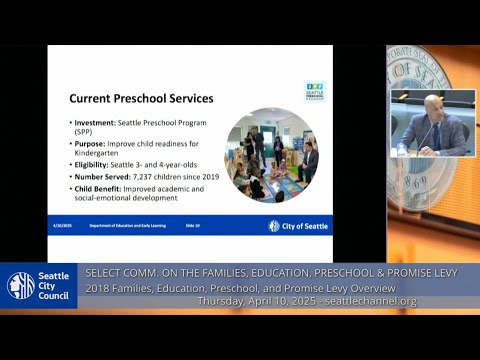
- Seattle Preschool Program (SPP): SPP provides tuition‑free or affordable preschool for 3‑ and 4‑year‑olds (a six‑hour day, 180‑day school year) using a mixed‑delivery model across Seattle Public Schools and community providers. DEEL reported more than 7,200 children have participated since 2019, that enrollment has remained above 90 percent, and that an external evaluation by Education Northwest found SPP participants are better prepared for kindergarten with effects persisting into third grade. DEEL also noted national recognition (a CityHealth gold medal) for meeting quality benchmarks.
- K–12 supports and school‑based health centers: DEEL described grants to schools and community organizations that provide academic enrichment, tutoring, mentoring and basic‑needs supports, as well as a network of 29 school‑based health centers funded by the levy. DEEL said nearly 50,000 students have been served by the levy’s K–12 supports since 2019, and that utilization of the health centers rose about 15 percent compared with the prior school year (an increase of roughly 8,000 visits).
- Seattle Promise: The Seattle Promise program provides up to 90 credits of tuition‑free college to Seattle Public School graduates. Staff reported the program has expanded from three to 22 high schools and that more than 1,200 students have graduated from the Promise pathway since 2019. DEEL said 38 percent of Promise scholars identified as first‑generation college students and described higher than average two‑year completion and transfer rates in program comparisons.
Committee members asked about coordination, gaps and next steps. Councilmembers pressed staff on:
- continuity between providers (several committee members confirmed some CCAP providers also operate SPP classrooms to preserve continuity of care for families); - digital literacy and emerging needs tied to social media and students’ mental health (DEEL said digital literacy and 21st‑century skills are part of youth development work and that the city’s IT/digital equity investments exist outside the levy); - school district coordination (DEEL said it holds regular data and planning meetings with Seattle Public Schools and that SPS has representation on the FEPP Oversight Committee); - potential state and federal funding changes, including a noted reduction in proposed state ECAP funding and reported federal actions affecting Head Start and the U.S. Department of Education — DEEL said those developments would require monitoring and could increase local funding needs if state or federal support declines.
Chair Rivera and staff reiterated timeline and process: DEEL will return to the select committee with the mayor’s proposed renewal on April 24, staff will document questions from today’s briefing for follow up, and the committee will consider a vote to place the renewal package on the November ballot after those briefings. The committee took no formal final action on the levy today; the only recorded procedural action was adoption of the meeting agenda by unanimous consent.
Public comment: One remote speaker, David Haines, used his two‑minute allotment to criticize aspects of local childcare policy and regulation; his remarks were recorded on the public comment segment of the meeting.
What’s next: DEEL will present the mayor’s levy renewal proposal to this select committee on April 24 for further review and the committee expects to transmit a renewal package later in April for the November 2025 ballot. Staff said they will provide additional detail about funding sources, program capacity and how the levy would respond if state or federal funding is reduced.
(Agenda adoption was recorded by clerk and the committee adjourned at 12:35 p.m.)
Ending: The select committee held one substantive item — the FEPP overview and initial discussion — and scheduled follow‑up briefings as the city prepares a renewal package for voter consideration this fall.