Get Full Government Meeting Transcripts, Videos, & Alerts Forever!
Get email alerts on the Coastal Dune Restoration topic
No spam. Unsubscribe anytime.
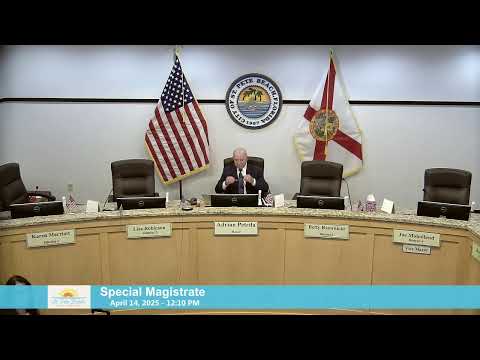
Special magistrate finds dune disturbance at Sunset Way; remedy deferred pending legal proposals
Summary
A St. Pete Beach special magistrate found that work using mechanized equipment had excavated a dune without a required permit at 2500/2502 Sunset Way but declined to classify the damage as irreparable or irreversible and reserved the remedy, asking parties to submit legal authority and a proposed resolution within seven days.
A special magistrate for the City of St. Pete Beach found on record that work that moved sand through the dune system at 2500 and 2502 Sunset Way occurred without the required permit, but she stopped short of declaring the damage irreparable or irreversible and gave the parties time to propose a way forward.
The finding came after the city presented photographs and a repair estimate and after testimony from the property owners’ expert, Britney Banco, a senior ecologist with Verdantus LLC, who testified that: “based on my physical inspection of the dune at these properties and my professional experience… the dune system has not been irreparably or irreversibly damaged by human activity.” Bancó also testified that natural forces and vegetative recruitment had largely restored the dune system to conditions consistent with post‑storm measurements.
City code enforcement officer Ayako Rakochelle said the city’s inspection showed vehicle track marks, use of mechanized equipment and suppression of vegetation at the dune, and presented an estimate prepared by Camden Mills, the city’s public services director, to restore the dune. Rakochelle told the magistrate the city’s recommended remedy included fines of $5,000 per violation (the maximum the code allows) and a $6,966 repair estimate per property (the estimate was prepared as a combined figure for both lots and then divided).
Attorney George Grambling, representing the property respondents, said his clients were not contesting that a permit was required and that they had been trying to resolve the matter. He introduced the contractor’s Facebook post and argued the property owners acted in “good intentions” after the storms, citing a city social media post the owners relied upon.
Special Magistrate Erica Augello said she found a violation of the city code section requiring a permit to conduct the work and found the evidence did not support an irreparable or irreversible classification. Augello said she was constrained by Chapter 162, Florida Statutes, and by the city code when fashioning remedies, and that because the city had presented evidence of a means to abate, the violation could not be labeled irreparable. She ordered that the parties each submit within seven days legal authority and proposed resolutions or proposed fines for the magistrate to consider and said she would issue a written order and (if needed) an amended order after reviewing submissions.
The magistrate also declined to assess daily running fines or authorize the property owners to re‑enter the dune to perform restoration work immediately; instead she required the permit process and review by appropriate regulatory agencies (including FDEP if required) be followed before abatement that affects the dune would proceed.
The magistrate’s order will set follow‑up steps and provide an opportunity for the parties to propose a final remedy or settlement; she said if the parties reach a settlement before she issues the amended order, they should inform the office so the matter can be closed without further hearing.
Ending: The magistrate’s written order will be issued and the parties have seven days from that order to submit legal authority and a proposed resolution. If no settlement is reached the magistrate indicated she would amend the order to specify a final remedy or penalty after reviewing the parties’ submissions.