Get Full Government Meeting Transcripts, Videos, & Alerts Forever!
Get email alerts on the Democracy Voucher topic
No spam. Unsubscribe anytime.
Committee votes 4-0 to send Seattle democracy voucher levy to the ballot
Summary
The Governance, Accountability and Economic Development Committee voted unanimously to recommend Council Bill 120957, a proposed 10-year, $45 million property-tax levy to continue funding Seattle’s democracy voucher program; the bill will go to full council for final consideration and, if approved, will appear on the August 5, 2025 ballot.
The Governance, Accountability and Economic Development Committee voted 4-0 on April 10 to recommend passage of Council Bill 120957, an ordinance that would place a 10-year property-tax levy before Seattle voters to continue funding the city’s democracy voucher program.
The bill would authorize a levy of $4.5 million a year, or $45 million over 10 years, to fund program administration and new participation levels; Council Central staff said that represents an increase from the current levy, which raises $3 million a year. Brian Goodnight of Council Central staff told the committee the proposal reflects inflation and higher program use and estimated the levy would add about $13.07 to the annual property-tax bill for the owner of a median-value residential property in 2026 (about $1.09 per month). Goodnight also said the city would exempt qualifying low-income seniors, veterans and people with disabilities from the increased levy amount as allowed by state law.
The committee’s action follows public comment from advocates and opponents during the committee’s hybrid public comment period. In-person speakers included Mauricio Yon of Washington Community Action Network, Estevan Munoz Howard of the People Powered Elections Washington Coalition and Aretha Basu, political director of Puget Sound Sage; each urged the committee to send the levy to voters. Munoz Howard said Seattle’s program has inspired other jurisdictions and has increased small-donor participation and candidate diversity. Basu said the vouchers help people who would otherwise be unable to contribute and stressed the program’s role in encouraging civic engagement.
One in-person commenter, Alex Zimmerman, and one remote commenter, David Haines, spoke critically of the city’s policies and of the voucher program’s administration; their remarks were recorded in the public comment period but the committee’s discussion and vote proceeded after the public comment period concluded.
During committee discussion, several members stressed that the bill merely places the levy on the ballot; final approval by the full City Council and voter approval are required for the levy to take effect. Council member Tekel, identified in the meeting as vice chair and a cosponsor, described the program as a tool to broaden participation, increase candidate diversity and strengthen local democracy. Council Central staff also described a provision in the bill to convene a work group in early 2026 to recommend administrative improvements to the program, including consideration of the effects of political action committees on Seattle elections. The work group, per the bill text discussed in committee, would include candidates, campaign staff, elections consultants, good-government advocates and members of the Seattle Ethics and Elections Commission.
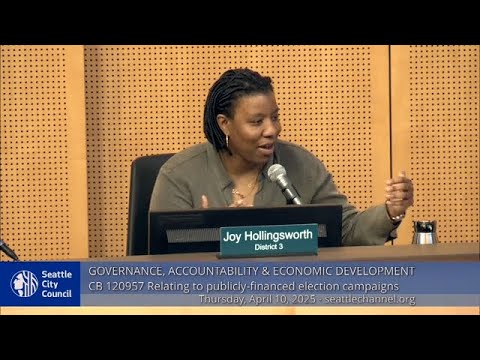
The committee approved the motion that the committee recommend passage of CB 120957; the motion was moved from the dais and a second was recorded. The roll-call vote was recorded as unanimous in favor: Council member Rivera — Aye; Council member Hollingsworth — Yes; Council member Kettle — Aye; Chair Sarah Nelson — Aye. Committee staff said that if the ordinance is approved by the full Council and the mayor, the City Clerk must file it with the King County Director of Elections by May 2 to meet the August 5, 2025 ballot deadline; Council Central staff also referenced an April full-council meeting in late April for further consideration (dates referenced during the meeting included April 21 and April 22).
The committee and speakers traced the program’s origin to a 2015 voter-approved levy that expires at the end of 2025; committee materials said that levy provided $3 million per year and $30 million over 10 years. Committee members and speakers emphasized that candidates who participate must meet program qualification requirements and engage in community forums and signature-gathering as part of their eligibility.
Next steps: the committee’s recommendation moves the ordinance to full Council consideration in late April; final placement on the August 5, 2025 ballot depends on subsequent Council action, mayoral approval and timely filing with King County elections.