Get Full Government Meeting Transcripts, Videos, & Alerts Forever!
Get email alerts on the Planning Zoning topic
No spam. Unsubscribe anytime.
Planning board debates PUD draft: ownership incentives, density bonuses and open-space rules draw the longest discussion
Summary
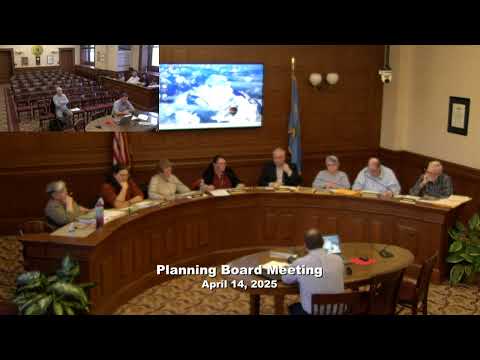
The board spent the majority of the meeting reviewing a draft Planned Unit Development ordinance. Members and staff debated definitions ("owner occupied" versus "resident controlled"), which development elements should be incentivized with density bonuses, bonus percentages and whether bonuses should stack; staff will revise and consult further.
The Lewiston Planning Board devoted extensive time to a redlined draft of a Planned Unit Development (PUD) ordinance, focusing on the document’s purpose, eligibility, permitted uses, flexibility, density‑bonus framework and open‑space rules. The session produced a range of policy questions rather than formal votes; staff said it will return with revisions and additional testing of the bonus math.
Purpose and definitions: Board members and staff debated language meant to encourage long‑term investment in place, focusing on phrasing to capture both housing and non‑housing forms of "ownership." Several members favored language that specifically promotes "owner‑occupied or resident‑controlled" units; others urged broader wording that would include resident cooperatives, business ownership models and collective stewardship. The board did not adopt a final definition at the meeting; staff agreed to provide examples and draft language options.
Density bonuses and incentives: A central focus was a proposed density bonus schedule to reward project elements that meet the PUD’s goals. Board members discussed sample bonus values presented by staff and suggested adjustments: traffic and road improvements (initially 20%), dedicated open space (10–15%), active recreation (15%), childcare (proposed 25% then discussed at 20–25%), public transportation/alternative transportation (discussion range 5–10%), and affordable/workforce housing (proposed at 1% increase in density per 1% of units designated affordable or workforce). The board debated whether bonuses should stack without cap and whether bonuses should be limited by project scale or geography; staff said it will run numerical tests and return with recommended limits and example scenarios.
Open space and common space: Board members asked for clarity on what counts as usable open space (contiguous, multiuse areas versus narrow buffer strips) and how to treat wetlands, ponds and other less‑developable land. Some members urged separate language for shared common spaces typical of townhouse or condominium development (shared courtyards, shared drive aisles and common internal amenities) rather than folding all requirements into an "open space" section.
Process and commercial vs. residential uses: Developers in the room urged staff to make the ordinance practical for commercial and industrial projects as well as residential ones. Applicant/consultant Mike Gatto told the board, "I've been pushing staff for 20 years to do a PUD ordinance," and asked for clarity that the rules would not unduly hinder commercially oriented projects. Staff said they had reviewed multiple models (including Auburn’s) and would test alternative approaches so the final ordinance works for mixed uses, commercial and industrial projects as appropriate.
Next steps: Staff agreed to revise the draft to (a) add clearer definitions and examples for "ownership" and eligible ownership models, (b) provide worked numerical examples showing how bonuses stack and the effect on density, (c) refine the open‑space/common‑space language and (d) consult further with Public Works, legal counsel and developers (including outreach to those who build in Auburn) before returning to the board.
Why it matters: The PUD ordinance, if adopted, would change the city’s development toolbox by formally allowing flexible design and targeted incentives to encourage affordable housing, stewardship models and site design that may not fit conventional subdivision rules. The board’s discussion indicates staff will continue to refine technical language and bonus calculations before formal public hearings or adoption steps.